The Georgia Court Watch issued its annual report on appellate courts.
ATLANTA – Court Watch today released its first annual report analyzing consumer-related decisions issued by the Supreme Court of Georgia and the Georgia Court of Appeals. Court Watch is a project of Georgia Watch, a nonprofit and nonpartisan group committed to strengthening the rights of consumers in Georgia .
The “2007 Annual Report” identifies and profiles the most noteworthy consumer-related decisions released by the appellate courts throughout the year, and identifies emerging trends.
“Many of the decisions reached by the state Supreme Court and Court of Appeals significantly impact the rights that consumers have under law,” said Georgia Watch Executive Director Allison Wall. “Georgia Watch launched this project to provide ongoing, thoughtful, fact-based analysis.”
Notable consumer cases discussed include:
* Glenn v. State, a case in which the court upheld Georgia ’s Payday Lending Law. Two individuals convicted of issuing payday loans argued that the statewide ban on payday lending was unconstitutionally vague and did not specifically prohibit the schemes they utilized in issuing loans, such as a “sales-leaseback” of a cell phone or coffee maker. The lenders also claimed they were not subject to the ban because they were located out-of-state.
* Kaminer v. Canas, in which the court upheld the two-year statute of limitations for medical misdiagnosis, regardless of futures failures to properly diagnosis, even in the presence of a patient’s additional or significantly worsened symptoms. In Georgia , a claim must be filed within two years of the date of the first misdiagnosis, whether or not the patient knows they have been misdiagnosed. In Kaminer v. Canas, the patient unsuccessfully argued that repeated misdiagnosis over a decade of treatment by multiple medical providers should have restarted the statute of limitations.
* Dees v. Logan, in which the court established that insurance companies are prohibited from creating offset clauses to reduce the amount owed to drivers who purchased uninsured motorist (UM) insurance. Offsets deny policyholders benefits already purchased that are needed to cover medical and property damage resulting from an accident with an underinsured driver. The court ruled that insurance policies containing offsets for personal injury benefits are in conflict with Georgia ’s Uninsured Motorist Act. This year, the Georgia General Assembly responded to this decision by passing Senate Bill 276, which expressly permits insurance carriers to use offsets for workers’ compensation benefits, effectively overturning part of this decision. SB 276 also expanded drivers’ access to UM coverage.
“Generally speaking, Georgia laws are not consumer-friendly,” Wall said. “As this report demonstrates, our courts generally follow those laws unless they explicitly run afoul of the state constitution.”
The Court Watch Fellowship is a collaborative effort of the 2007 Court Watch Fellowship recipient and primary researcher, Nathan Gaffney, and the Court Watch Advisory Committee, which includes three members of the Executive Committee of the State Bar of Georgia Board of Governors.
“Any contention that our appellate judges are activists who stray from the letter of the law is not supported by these decisions concerning consumer rights,” said Tom Stubbs, Court Watch Advisory Committee member. “Indeed, even when statutes can reasonably be interpreted in different ways, our courts have a pronounced bent not to interpret them so as to enhance protection of consumers in our state.”
Friday, June 13, 2008
Did Glaxo Suppress Paxil Safety Data and "Bamboozle" the FDA?
A U.S. Senator thinks so.
From various reports: GOP Senator Grassley has asked the FDA to study an overseas report issued several months ago that concluded that Glaxo suppressed Paxil data going back to 1998. Glaxo had said risks came to light in in 2006.
``It looks like GlaxoSmithKline bamboozled the FDA,'' Grassley said this week. speech. ``We cannot live in a nation where drug companies are less than candid, hide information and attempt to mislead the FDA and the public." Per Bloomberg.
Well Senator, we do and it's not going to change unless there is a seismic shift in the way the FDA does business.
From various reports: GOP Senator Grassley has asked the FDA to study an overseas report issued several months ago that concluded that Glaxo suppressed Paxil data going back to 1998. Glaxo had said risks came to light in in 2006.
``It looks like GlaxoSmithKline bamboozled the FDA,'' Grassley said this week. speech. ``We cannot live in a nation where drug companies are less than candid, hide information and attempt to mislead the FDA and the public." Per Bloomberg.
Well Senator, we do and it's not going to change unless there is a seismic shift in the way the FDA does business.

Thursday, June 12, 2008
FDA's Abysmal Failures
This time, tomatoes.
From various reports:
"As foodborne illness outbreaks continue, FDA is missing valuable opportunities to reassure Congress and the public that it is doing all it can to protect the nation's food supply," said the report by the investigative arm of Congress. Source.
One word used by Bart Stupak, chairman of the House subcommittee on oversight and investigation aptly describes this mess. "Pathetic."
This is an agency that is supposed to address safety when it comes to unsafe drugs, but can't even get to the source of bad vegetables. "Too bad that the federal government and the FDA have bowed to big corporate interests in refusing to fund or implement U.S. law requiring country-of-origin labeling for produce: labeling that could have nipped this latest outbreak in the bud." So says Mr. Dobbs. The FDA may "never" find the source.
Video here.
From various reports:
"As foodborne illness outbreaks continue, FDA is missing valuable opportunities to reassure Congress and the public that it is doing all it can to protect the nation's food supply," said the report by the investigative arm of Congress. Source.
One word used by Bart Stupak, chairman of the House subcommittee on oversight and investigation aptly describes this mess. "Pathetic."
This is an agency that is supposed to address safety when it comes to unsafe drugs, but can't even get to the source of bad vegetables. "Too bad that the federal government and the FDA have bowed to big corporate interests in refusing to fund or implement U.S. law requiring country-of-origin labeling for produce: labeling that could have nipped this latest outbreak in the bud." So says Mr. Dobbs. The FDA may "never" find the source.
Video here.
Monday, June 09, 2008
Epilepsy Drugs (Topamax and others) to get Suicide Warning
The FDA is in the final states of including language warning about suicidal behavior on labels of 11 epilepsy drugs. Sales of the affected drugs, widely used for nonepilepsy problems such as chronic pain, topped $8 billion last year.
From various sources, including the WSJ Blog.
The drugs include:
* Carbatrol, Equetro, Tegretol, Tegretol XR,
* Felbatol,
* Neurontin,
* Lyrica,
* Gabitril,
* Topamax, and
* Depakote
From various sources, including the WSJ Blog.
The drugs include:
* Carbatrol, Equetro, Tegretol, Tegretol XR,
* Felbatol,
* Neurontin,
* Lyrica,
* Gabitril,
* Topamax, and
* Depakote
Regranex Warning from the FDA
Regranex is a topical cream indicated for the treatment of leg and foot ulcers that are not healing in diabetic patients.
The WARNINGS section of the product has been updated to include a BOXED WARNING and a description of the epidemiologic data that is the basis for the revised label. These data come from a retrospective study that compared cancer incidence and cancer mortality among 1,622 patients exposed to Regranex to 2,809 otherwise similar patients who were not exposed. The results were consistent with no overall increase in cancer incidence among the patients exposed to Regranex. However, there was a five-fold increased risk of cancer mortality in the group exposed to three or more tubes of Regranex.
"In announcing this label change, FDA still cautions health care professionals to carefully weigh the risks and benefits of treating patients with Regranex," said Susan Walker, M.D., director of the Division of Dermatological and Dental Products. "Regranex is not recommended for patients with known malignancies."
In late March FDA issued an Ongoing Safety Review Communication on Regranex notifying the public that it was conducting a safety review. This follow-up communication is in keeping with FDA’s commitment to notify the public of any regulatory changes with this FDA approved product.
Regranex is a medicine that is a recombinant form of human platelet-derived growth factor which is applied directly to diabetic foot and leg ulcers that are not healing. The recombinant form of platelet growth factor has a biologic activity that is much like that produced naturally by the body. Growth factors cause cells to divide more rapidly. It is for this reason that the manufacturer continued to monitor studies begun before Regranex was approved in December 1997 for any evidence of adverse effects such as increased numbers of cancers. In a long term safety study completed in 2001, there were more deaths from cancer in people who used Regranex than in those who did not use it.
Following the report of the study completed in 2001, an additional study was performed using a health insurance database that covered the period from January, 1998 through June, 2003. This study used the database to identify two groups of patients with similar diagnoses, drug use, and use of health services, one of which used Regranex and one group that did not. The results of this study showed that deaths from cancer were higher for patients who were given three or more prescriptions for treatment with Regranex than those who were not treated with Regranex. No single type of cancer was identified, but rather deaths from all types of cancer, combined were observed.
For more, go here.
The WARNINGS section of the product has been updated to include a BOXED WARNING and a description of the epidemiologic data that is the basis for the revised label. These data come from a retrospective study that compared cancer incidence and cancer mortality among 1,622 patients exposed to Regranex to 2,809 otherwise similar patients who were not exposed. The results were consistent with no overall increase in cancer incidence among the patients exposed to Regranex. However, there was a five-fold increased risk of cancer mortality in the group exposed to three or more tubes of Regranex.
"In announcing this label change, FDA still cautions health care professionals to carefully weigh the risks and benefits of treating patients with Regranex," said Susan Walker, M.D., director of the Division of Dermatological and Dental Products. "Regranex is not recommended for patients with known malignancies."
In late March FDA issued an Ongoing Safety Review Communication on Regranex notifying the public that it was conducting a safety review. This follow-up communication is in keeping with FDA’s commitment to notify the public of any regulatory changes with this FDA approved product.
Regranex is a medicine that is a recombinant form of human platelet-derived growth factor which is applied directly to diabetic foot and leg ulcers that are not healing. The recombinant form of platelet growth factor has a biologic activity that is much like that produced naturally by the body. Growth factors cause cells to divide more rapidly. It is for this reason that the manufacturer continued to monitor studies begun before Regranex was approved in December 1997 for any evidence of adverse effects such as increased numbers of cancers. In a long term safety study completed in 2001, there were more deaths from cancer in people who used Regranex than in those who did not use it.
Following the report of the study completed in 2001, an additional study was performed using a health insurance database that covered the period from January, 1998 through June, 2003. This study used the database to identify two groups of patients with similar diagnoses, drug use, and use of health services, one of which used Regranex and one group that did not. The results of this study showed that deaths from cancer were higher for patients who were given three or more prescriptions for treatment with Regranex than those who were not treated with Regranex. No single type of cancer was identified, but rather deaths from all types of cancer, combined were observed.
For more, go here.
Thursday, June 05, 2008
News on Tumor Necrosis Factor Blockers
Tumor Necrosis Factor blockers like Remicade, Enbrel, Humira, and Cimzia may be impacted by a recent FDA investigation.
From the FDA:
The FDA is investigating the possible association between the use of medicines known as tumor necrosis factor (TNF) blockers and the development of lymphoma and other cancers in children and young adults. These individuals were treated with TNF blockers for Juvenile Idiopathic Arthritis (JIA), Crohn’s disease or other diseases. JIA is the new name for what was called Juvenile Rheumatoid Arthritis (JRA).
Source here.
From the FDA:
The FDA is investigating the possible association between the use of medicines known as tumor necrosis factor (TNF) blockers and the development of lymphoma and other cancers in children and young adults. These individuals were treated with TNF blockers for Juvenile Idiopathic Arthritis (JIA), Crohn’s disease or other diseases. JIA is the new name for what was called Juvenile Rheumatoid Arthritis (JRA).
Source here.
Tuesday, June 03, 2008
More Bad News on Chantix
Hundreds of accidents have been linked to Chantix according to a study by outside researchers. The report was issued by the Institute for Safe Medication Practices.
The researchers say the number of convulsions for people taking Chantix is at least 86 since the drug went on the market in 2006. (Per the WSJ Blog).The WSJ Blog is worth a read.
The researchers say the number of convulsions for people taking Chantix is at least 86 since the drug went on the market in 2006. (Per the WSJ Blog).The WSJ Blog is worth a read.
Monday, June 02, 2008
FDA: Baby Formula Recalled
Two lots of baby formula have been recalled.
Abbott Laboratories says it is voluntarily recalling two lots of Calcilo XD Low-Calcium/Vitamin D-Free Infant Formula with Iron powder.
The formula is specially designed for infants and children with hypercalcemia - high levels of calcium - in their blood.
The FDA web site says the formula was distributed in Canada and the U.S. between June 6, 2006 and April 17, 2008. It is only available by special order.
The recall is limited to Calcilo XD in 400g cans, with stock code number 00378 and lot numbers 39973RB or 47239RB6 printed on the bottom of the cans. No other Calcilo XD powdered infant formulas are affected.
The company says small amounts of air may have entered the can, resulting in oxidation of the formula, which can often be detected by an off odour.
The FDA says consumption of highly oxidized foods can cause gastrointestinal symptoms such as nausea, vomiting and diarrhea. If parents have questions or concerns, the release says they should contact a health care professional.
Source here.
Abbott Laboratories says it is voluntarily recalling two lots of Calcilo XD Low-Calcium/Vitamin D-Free Infant Formula with Iron powder.
The formula is specially designed for infants and children with hypercalcemia - high levels of calcium - in their blood.
The FDA web site says the formula was distributed in Canada and the U.S. between June 6, 2006 and April 17, 2008. It is only available by special order.
The recall is limited to Calcilo XD in 400g cans, with stock code number 00378 and lot numbers 39973RB or 47239RB6 printed on the bottom of the cans. No other Calcilo XD powdered infant formulas are affected.
The company says small amounts of air may have entered the can, resulting in oxidation of the formula, which can often be detected by an off odour.
The FDA says consumption of highly oxidized foods can cause gastrointestinal symptoms such as nausea, vomiting and diarrhea. If parents have questions or concerns, the release says they should contact a health care professional.
Source here.
Depo Provera Class Action in Canada
From Bloomberg:
Pfizer's being sued by Canadian women who claim the company failed to provide proper notice the contraceptive Depo-Provera causes loss of bone density. The pending case won a broad (for Canada) national class-action certification.
For more go here.
Pfizer's being sued by Canadian women who claim the company failed to provide proper notice the contraceptive Depo-Provera causes loss of bone density. The pending case won a broad (for Canada) national class-action certification.
For more go here.
Tuesday, May 27, 2008
Truckers: Don't Take Chantix
The Federal Motor Carrier Safety Administration, which regulates the trucking and bus industries, says that anyone taking Chantix shouldn't be allowed to drive. The Department of Transportation has alerted the heads of its myriad sub-agencies to the Chantix study and told them to take note of its findings and recommendations.set
The study found 988 cases of Chantix causing serious health problems, including seizures and heart trouble, in the last quarter of 2007 alone. It also found possible links to seizures, dizziness, heart irregularity, diabetes and more than 100 accidents.
For more go here.
The study found 988 cases of Chantix causing serious health problems, including seizures and heart trouble, in the last quarter of 2007 alone. It also found possible links to seizures, dizziness, heart irregularity, diabetes and more than 100 accidents.
For more go here.
Friday, May 23, 2008
Lawyers/Firms With Bad Web Sites: Why Bother?
This week, not once but three times I have been searching out lawyers for various matters in other states. I am pretty sure that the litigators I sought out would not dare take even a basic deposition without being prepared, yet I am amazed at how little time is spent on a firm's web site. Several sites, to be blunt, conveyed a podunk image. The firms deserve better.
What did I find (or not find)? One site did not list a telephone number on any page except the contact us page.
One firm did not list any email contact, nor did it have a Consultation Form anywhere on the site. (For a good example of this form, go to my friend Richard Shapiro's site, here). No toll free number either.
These types of mistakes cost a firm money - lost opportunity, lost referral, lost potential clients. To me it shows a lack of understanding of the basics of the web. Worse, it means that I just move on to the next firm.
Is your firm's site one that I visited?
What did I find (or not find)? One site did not list a telephone number on any page except the contact us page.
One firm did not list any email contact, nor did it have a Consultation Form anywhere on the site. (For a good example of this form, go to my friend Richard Shapiro's site, here). No toll free number either.
These types of mistakes cost a firm money - lost opportunity, lost referral, lost potential clients. To me it shows a lack of understanding of the basics of the web. Worse, it means that I just move on to the next firm.
Is your firm's site one that I visited?
Oral Hormone Therapy Doubles Clot Risk
From Reuters:
Menopausal women taking hormone-replacement therapy pills may be at risk in excess of two times normal of developing a blood clot.
"This meta-analysis ... showed that current use of oral oestrogen increases the risk of (blood clots) by two-fold to three-fold," Pierre-Yves Scarabin and Marianne Canonico of the Paul Brousse Hospital in France wrote.
Link is here.
Menopausal women taking hormone-replacement therapy pills may be at risk in excess of two times normal of developing a blood clot.
"This meta-analysis ... showed that current use of oral oestrogen increases the risk of (blood clots) by two-fold to three-fold," Pierre-Yves Scarabin and Marianne Canonico of the Paul Brousse Hospital in France wrote.
Link is here.
Thursday, May 22, 2008
Tech: Zombies Among Us?
Tech Zombies that is. I am seeing what (to me) is a new phenomenon - texting or emailing while walking. I saw a man lurching oddly across a parking lot, and honestly thought something was wrong ... it was. Seems that he was working a phone --- hard --- while maneuvering the hazards of parking spaces.
Like this:
Someone is going to get killed doing this, don't you think?
Like this:
Someone is going to get killed doing this, don't you think?
Ad comes back to bite Life Lock
Have you seen the Life Lock ad, the one where the company chief gives out his Social Security Number and dares anyone to use it?
From the web:
"Davis (the company honcho) acknowledged in an interview with The Associated Press that his stunt has led to at least 87 instances in which people have tried to steal his identity, and one succeeded: a guy in Texas who duped an online payday loan operation last year into giving him $500 using Davis' Social Security number."
And there is more ... "Attorney David Paris said he found records of other people applying for or receiving driver's licenses at least 20 times using Davis' Social Security number, though some of the applications may have been rejected because data in them didn't match what the Social Security Administration had on file."
Go here for more.
Is this the end for Lifelock?
From the web:
"Davis (the company honcho) acknowledged in an interview with The Associated Press that his stunt has led to at least 87 instances in which people have tried to steal his identity, and one succeeded: a guy in Texas who duped an online payday loan operation last year into giving him $500 using Davis' Social Security number."
And there is more ... "Attorney David Paris said he found records of other people applying for or receiving driver's licenses at least 20 times using Davis' Social Security number, though some of the applications may have been rejected because data in them didn't match what the Social Security Administration had on file."
Go here for more.
Is this the end for Lifelock?
Wednesday, May 21, 2008
The U.S. Supreme Court, the FDA and Reality
While the U.S. Supreme Court traces the history of how a device gets approved, the reality of the FDA is to me much different.
From the Denver Post:
The Food and Drug Administration has finally acknowledged that it needs more resources to protect consumers from tainted food and drugs.
Unfortunately, it took the deaths of 81 people, a browbeating by members of Congress and a report detailing the FDA's woeful inability to expand overseas inspections before top agency officials would ask for more money.
It was a puzzling situation and one that has to make you wonder whether the Bush administration was putting the bottom line ahead of the health and safety of the American public.
Last week, FDA Commissioner Andrew C. von Eschenbach finally wrote Congress to say the agency needs an extra $275 million to make sure that food, drugs and medical devices from overseas are safe. The Senate appropriations committee quickly approved the request.
Given the high-profile instances of tainted products in recent years, it has become abundantly clear that the FDA does not have the resources to adequately inspect rising numbers of imports.
Last year, there was a string of pet deaths from melamine-contaminated wheat gluten imported from China. This year, the deaths of 81 people have been linked to tainted batches of the blood-thinning drug Heparin, also imported from China.
It's long past time to fix the FDA.
From the Denver Post:
The Food and Drug Administration has finally acknowledged that it needs more resources to protect consumers from tainted food and drugs.
Unfortunately, it took the deaths of 81 people, a browbeating by members of Congress and a report detailing the FDA's woeful inability to expand overseas inspections before top agency officials would ask for more money.
It was a puzzling situation and one that has to make you wonder whether the Bush administration was putting the bottom line ahead of the health and safety of the American public.
Last week, FDA Commissioner Andrew C. von Eschenbach finally wrote Congress to say the agency needs an extra $275 million to make sure that food, drugs and medical devices from overseas are safe. The Senate appropriations committee quickly approved the request.
Given the high-profile instances of tainted products in recent years, it has become abundantly clear that the FDA does not have the resources to adequately inspect rising numbers of imports.
Last year, there was a string of pet deaths from melamine-contaminated wheat gluten imported from China. This year, the deaths of 81 people have been linked to tainted batches of the blood-thinning drug Heparin, also imported from China.
It's long past time to fix the FDA.
Tuesday, May 20, 2008
Google Health, Part 2
I found this on the Google Health site: To join, users must agree to various terms of use, including this: "When you provide your information through Google Health, you give Google a license to use and distribute it in connection with Google Health and other Google services." Doesn't give me a warm and fuzzy feeling - do you feel better knowing that perhaps an old knee injury, or a diabetes condition may be "distribute[d]" by Google?
At the outset, there are companies such as Aetna and BCBS which have been in the online medical records business for some time. Google brings it together in 18 months ... and with only a limited set of partners, and an "advisory council."
Implementation: How will this work with the average consumer? I'm helping a client now who was badly injured in an incident. The medical records in this client's file from one incident exceeds 300 pages, none of which came to our office scanned. The client has an extensive history of medical problems, and this "unrelated" set of records is nearly 200 pages.
Let's presume that this person never went to an attorney, just had health issues. Person is more than age 50 - who scans 500 pages to upload to Google? Where does this person go to scan? Who will spend hours uploading?
From various sites, these comments:
One commentator says, "Early on, the program will rely mostly on a patient's own input because of the lack of partners outside of early signees such as The Cleveland Clinic Foundation and drug store chain Walgreens Co. "When it comes to lab data and medical history and those kinds of things, doctors rely today on reliable sources -- not the consumers themselves," Source here.
"Some observers have expressed concern that much of the information stored in Google Health will not be covered by the USA’s Health Insurance Portability and Accountability Act." Source here.
My prediction- ads from Big Pharma will debut on the site within 12 months, and I will be shocked if 1% of the population uses this site. Stay tuned.
At the outset, there are companies such as Aetna and BCBS which have been in the online medical records business for some time. Google brings it together in 18 months ... and with only a limited set of partners, and an "advisory council."
Implementation: How will this work with the average consumer? I'm helping a client now who was badly injured in an incident. The medical records in this client's file from one incident exceeds 300 pages, none of which came to our office scanned. The client has an extensive history of medical problems, and this "unrelated" set of records is nearly 200 pages.
Let's presume that this person never went to an attorney, just had health issues. Person is more than age 50 - who scans 500 pages to upload to Google? Where does this person go to scan? Who will spend hours uploading?
From various sites, these comments:
One commentator says, "Early on, the program will rely mostly on a patient's own input because of the lack of partners outside of early signees such as The Cleveland Clinic Foundation and drug store chain Walgreens Co. "When it comes to lab data and medical history and those kinds of things, doctors rely today on reliable sources -- not the consumers themselves," Source here.
"Some observers have expressed concern that much of the information stored in Google Health will not be covered by the USA’s Health Insurance Portability and Accountability Act." Source here.
My prediction- ads from Big Pharma will debut on the site within 12 months, and I will be shocked if 1% of the population uses this site. Stay tuned.
Google Health Debuts
From the site, below. From the blog: "One of the most exciting and innovative parts of Google Health is our platform strategy. We're assembling a directory of third-party services that interoperate with Google Health. Right now, this means you'll be able to automatically import information such as your doctors' records, your prescription history, and your test results into Google Health in order to easily access and control your data. Later, this platform strategy will mean that you will be able to interact with services and tools easily, and will be able to do things like schedule appointments, refill prescriptions, and start using new wellness tools." Link here.
Page one of Google Health, here.
About Google Health
Google Health allows you to store and manage all of your health information in one central place. And it's completely free. All you need to get started is a Google username and password.
Google believes that you own your medical records and should have easy access to them. The way we see it, it's your information; why shouldn't you control it?
* Keep your doctors up-to-date
* Stop filling out the same paperwork every time you see a new doctor
* Avoid getting the same lab tests done over and over again because your doctor cannot get copies of your latest results
* Don't lose your medical records because of a move, change in jobs or health insurance
Page one of Google Health, here.
About Google Health
Google Health allows you to store and manage all of your health information in one central place. And it's completely free. All you need to get started is a Google username and password.
Google believes that you own your medical records and should have easy access to them. The way we see it, it's your information; why shouldn't you control it?
* Keep your doctors up-to-date
* Stop filling out the same paperwork every time you see a new doctor
* Avoid getting the same lab tests done over and over again because your doctor cannot get copies of your latest results
* Don't lose your medical records because of a move, change in jobs or health insurance
Monday, May 19, 2008
Tuesday, May 13, 2008
Spy on Your Friends
Or so says the WSJ in today's paper version. There are tools/sites to make it easier to "snoop."
The sites include:
Zabasearch.com: The site's tagline is: Telephone Numbers and Addresses Revealed Free
Wink.com:From the site - Wink People Search provides free people search across over 400 Million profiles from across the Internet - including Facebook, MySpace, LinkedIn, and all the other big social networks. You can search for people by name, location, work,and more
Spokeo.com: The site's main page says: Spokeo searches your friends' blogs and photos across 41 social networks so you don't have to visit hundreds of websites one by one.
Worth a look.
My friend, attorney Ed Lake from New York is a fan of zabasearch.com. Ed's office is located at: 270 West Main Street, Sayville, New York.
The sites include:
Zabasearch.com: The site's tagline is: Telephone Numbers and Addresses Revealed Free
Wink.com:From the site - Wink People Search provides free people search across over 400 Million profiles from across the Internet - including Facebook, MySpace, LinkedIn, and all the other big social networks. You can search for people by name, location, work,and more
Spokeo.com: The site's main page says: Spokeo searches your friends' blogs and photos across 41 social networks so you don't have to visit hundreds of websites one by one.
Worth a look.
My friend, attorney Ed Lake from New York is a fan of zabasearch.com. Ed's office is located at: 270 West Main Street, Sayville, New York.
Wednesday, May 07, 2008
Tips: UpgradeYour Life
I'm not talking about learning CPR or adopting a child, just everyday upgrades. From Lifehacker:
A list that will help you start the handle the endless items each day that dog you. The list includes:
Hack 8: Consolidate Multiple Email Addresses with Gmail
Hack 12: Instantly Retrieve Files Stored on Your Hard Drive
Hack 21: Design Your Own Planner
Take the time to look at the post. It's the best 15 minutes you will spend this week.
Go here for more.
A list that will help you start the handle the endless items each day that dog you. The list includes:
Hack 8: Consolidate Multiple Email Addresses with Gmail
Hack 12: Instantly Retrieve Files Stored on Your Hard Drive
Hack 21: Design Your Own Planner
Take the time to look at the post. It's the best 15 minutes you will spend this week.
Go here for more.
Tuesday, May 06, 2008
Walmart's $10 Meds
From the Walmart Releases:
Beginning today, Wal-Mart, Neighborhood Market and Sam's Club pharmacies will fill prescriptions for up to 350 generic medications at $10 for a 90-day supply. This option will give customers an additional choice and save them time and money without the hassle of purchasing or signing-up for a pharmacy discount card.
You can find the list of drugs here (PDF Alert).
.
Beginning today, Wal-Mart, Neighborhood Market and Sam's Club pharmacies will fill prescriptions for up to 350 generic medications at $10 for a 90-day supply. This option will give customers an additional choice and save them time and money without the hassle of purchasing or signing-up for a pharmacy discount card.
You can find the list of drugs here (PDF Alert).
.
Friday, May 02, 2008
Vioxx Deadline Extended: June 30, 2008
Merck report this week that more than ninety percent of eligible U.S. claimants have elected to participate in its $4.85 billion proposed Vioxx settlement, and the drugmaker extended the deadline to opt in.
Merck said that, while it was satisfied with signing up the vast majority of potential participants, it was extending by two months -- until June 30 -- the deadline for remaining eligible former users of its withdrawn arthritis drug to enroll in its proposed settlement.
Link here.
Merck said that, while it was satisfied with signing up the vast majority of potential participants, it was extending by two months -- until June 30 -- the deadline for remaining eligible former users of its withdrawn arthritis drug to enroll in its proposed settlement.
Link here.
Thursday, May 01, 2008
Total Body Formula Lawsuit Filed in Georgia
Today my office filed a lawsuit for a client who claims she was injured because of an unsafe supplement known as Total Body Formula.
You may view the first two pages of the Complaint here.
The Total Body Formula product was sold in eight-ounce and 32-ounce plastic bottles. The Total Body Mega Formula is sold in 32-ounce plastic bottles. Both products are distributed by Total Body Essential Nutrition of Atlanta. The company is the sole distributor of the products and has voluntarily recalled Total Body Formula in the flavors of Tropical Orange and Peach Nectar and Total Body Mega Formula in Orange/Tangerine flavor.
The supplements were recalled, and the recalled Lots are: # 4016801, 4016802, 4024801, 4031801, 4031802 or 4031803.
The liquid dietary supplement products may cause severe adverse reactions, including nausea, vomiting and diarrhea, joint pain and fatigue. These symptoms can be followed by hair loss, nail brittleness and neurological abnormalities (such as numbness and other odd sensations in the hands, arms, legs or feet).
The FDA site informs:
The Florida Department of Health recently provided reports to the FDA on 23 individuals who experienced serious reactions to these products seven to 10 days after ingestion. In all cases, the reactions included significant hair loss, muscle cramps, diarrhea, joint pain and fatigue. The FDA subsequently learned and is investigating a report that some individuals in Tennessee using the same products have experienced similar reactions.
FDA laboratories are analyzing samples of the products to identify the cause of the reactions, including the possibility that the products contain excessive amounts of selenium, which is known to cause symptoms such as those described in the adverse events reported to the agency. Selenium, a trace mineral, is needed only in small amounts for good health.
The products have been distributed in Alabama, California, Florida, Georgia, Kentucky, Louisiana, Michigan, Missouri, New Jersey, North Carolina, Ohio, Pennsylvania, Tennessee, Texas and Virginia.
The FDA is advising consumers in all states to avoid using the products immediately and to discard the products by placing them in a trash receptacle outside of the home.
Source here.
On May 1, 2008, this news from the FDA:
FDA Completes Final Analysis of "Total Body Formula" and "Total Body Mega Formula" Products
Testing reveals high chromium levels in addition to selenium
The U.S. Food and Drug Administration’s final analysis of certain flavors of "Total Body Formula" and "Total Body Mega Formula” has detected hazardous amounts of chromium.
On April 9, 2008, the FDA reported the dietary supplement products contained hazardous amounts of selenium in samples of "Total Body Formula" in Tropical Orange and Peach Nectar flavors and "Total Body Mega Formula" in the Orange/Tangerine flavor. Further FDA analysis of the products found high levels of chromium as well. The samples contained up to 3,426 micrograms of chromium for the recommended serving (17 times the recommended intake). The recommended chromium intake for an adult ranges from 35 to 45 micrograms per day.
Excessive consumption of chromium can cause fatigue, muscle cramps, hyperactivity, hypoglycemia, renal failure and liver toxicity. Excessive chromium intake also can interfere with certain medications.
The new FDA finding comes as the U.S. Centers for Disease Control and Prevention (CDC) reports that the number of confirmed cases of adverse reactions in consumers using the products has climbed to at least 201 individuals in Alabama, Florida, Georgia, Kentucky, Michigan, New Jersey, North Carolina, Tennessee, Texas and Virginia.
Consumers were first cautioned March 27, 2008 not to purchase and to discontinue the use of "Total Body Formula" in Tropical Orange and Peach Nectar flavors and "Total Body Mega Formula" in the Orange/Tangerine flavor after receiving reports of adverse reactions. (http://www.fda.gov/bbs/topics/NEWS/2008/NEW01812.html).
The FDA continues to investigate how excessive amounts of selenium and chromium got into the products.
The sole distributor of the "Total Body Formula" and "Total Body Mega Formula" products has voluntarily recalled the affected products.
You may view the first two pages of the Complaint here.

The Total Body Formula product was sold in eight-ounce and 32-ounce plastic bottles. The Total Body Mega Formula is sold in 32-ounce plastic bottles. Both products are distributed by Total Body Essential Nutrition of Atlanta. The company is the sole distributor of the products and has voluntarily recalled Total Body Formula in the flavors of Tropical Orange and Peach Nectar and Total Body Mega Formula in Orange/Tangerine flavor.
The supplements were recalled, and the recalled Lots are: # 4016801, 4016802, 4024801, 4031801, 4031802 or 4031803.
The liquid dietary supplement products may cause severe adverse reactions, including nausea, vomiting and diarrhea, joint pain and fatigue. These symptoms can be followed by hair loss, nail brittleness and neurological abnormalities (such as numbness and other odd sensations in the hands, arms, legs or feet).
The FDA site informs:
The Florida Department of Health recently provided reports to the FDA on 23 individuals who experienced serious reactions to these products seven to 10 days after ingestion. In all cases, the reactions included significant hair loss, muscle cramps, diarrhea, joint pain and fatigue. The FDA subsequently learned and is investigating a report that some individuals in Tennessee using the same products have experienced similar reactions.
FDA laboratories are analyzing samples of the products to identify the cause of the reactions, including the possibility that the products contain excessive amounts of selenium, which is known to cause symptoms such as those described in the adverse events reported to the agency. Selenium, a trace mineral, is needed only in small amounts for good health.
The products have been distributed in Alabama, California, Florida, Georgia, Kentucky, Louisiana, Michigan, Missouri, New Jersey, North Carolina, Ohio, Pennsylvania, Tennessee, Texas and Virginia.
The FDA is advising consumers in all states to avoid using the products immediately and to discard the products by placing them in a trash receptacle outside of the home.
Source here.
On May 1, 2008, this news from the FDA:
FDA Completes Final Analysis of "Total Body Formula" and "Total Body Mega Formula" Products
Testing reveals high chromium levels in addition to selenium
The U.S. Food and Drug Administration’s final analysis of certain flavors of "Total Body Formula" and "Total Body Mega Formula” has detected hazardous amounts of chromium.
On April 9, 2008, the FDA reported the dietary supplement products contained hazardous amounts of selenium in samples of "Total Body Formula" in Tropical Orange and Peach Nectar flavors and "Total Body Mega Formula" in the Orange/Tangerine flavor. Further FDA analysis of the products found high levels of chromium as well. The samples contained up to 3,426 micrograms of chromium for the recommended serving (17 times the recommended intake). The recommended chromium intake for an adult ranges from 35 to 45 micrograms per day.
Excessive consumption of chromium can cause fatigue, muscle cramps, hyperactivity, hypoglycemia, renal failure and liver toxicity. Excessive chromium intake also can interfere with certain medications.
The new FDA finding comes as the U.S. Centers for Disease Control and Prevention (CDC) reports that the number of confirmed cases of adverse reactions in consumers using the products has climbed to at least 201 individuals in Alabama, Florida, Georgia, Kentucky, Michigan, New Jersey, North Carolina, Tennessee, Texas and Virginia.
Consumers were first cautioned March 27, 2008 not to purchase and to discontinue the use of "Total Body Formula" in Tropical Orange and Peach Nectar flavors and "Total Body Mega Formula" in the Orange/Tangerine flavor after receiving reports of adverse reactions. (http://www.fda.gov/bbs/topics/NEWS/2008/NEW01812.html).
The FDA continues to investigate how excessive amounts of selenium and chromium got into the products.
The sole distributor of the "Total Body Formula" and "Total Body Mega Formula" products has voluntarily recalled the affected products.
Wednesday, April 30, 2008
Central United Class Action
My friend and fellow attorney Joey James has asked me to post this about a pending class action and a proposed $650 payment to certain class members:
A national class action has been filed against Central United Life Insurance Company. Central United and the Class Representatives have agreed to enter into a settlement agreement in a state court in Alabama. Lawyers for Central United and lawyers for the two people that have brought this class action have negotiated a settlement between Central United and the Class Representatives.
This settlement agreement has been reached without any trial or open hearings where others could tell what has happened to them. This settlement agreement will be binding on every Central United insured in this country if a person does not opt out and the trial court finally approves the settlement without appeal.
What does this mean? This means that if you do not opt out by June 3, 2008, and the trial court agrees with this settlement and it is not appealed, you will be stuck with whatever Central United has agreed to pay and there will be absolutely nothing you can do about it. So, if your cancer insurance is important to you, you must read the agreement and opt out if you do not want to be bound by it.
If you are unsure of what to do, call Bunch & James toll free at 1-877-882-0095 or email the office at joey@bunchandjames.com
A national class action has been filed against Central United Life Insurance Company. Central United and the Class Representatives have agreed to enter into a settlement agreement in a state court in Alabama. Lawyers for Central United and lawyers for the two people that have brought this class action have negotiated a settlement between Central United and the Class Representatives.
This settlement agreement has been reached without any trial or open hearings where others could tell what has happened to them. This settlement agreement will be binding on every Central United insured in this country if a person does not opt out and the trial court finally approves the settlement without appeal.
What does this mean? This means that if you do not opt out by June 3, 2008, and the trial court agrees with this settlement and it is not appealed, you will be stuck with whatever Central United has agreed to pay and there will be absolutely nothing you can do about it. So, if your cancer insurance is important to you, you must read the agreement and opt out if you do not want to be bound by it.
If you are unsure of what to do, call Bunch & James toll free at 1-877-882-0095 or email the office at joey@bunchandjames.com
Sunday, April 27, 2008
Total Body Formula Recalled
A Supplement has been recalled because of an error in its preparation.
The Total Body Formula products were sold in eight-ounce and 32-ounce plastic bottles. The Total Body Mega Formula is sold in 32-ounce plastic bottles. Both products are distributed by Total Body Essential Nutrition of Atlanta. The company is the sole distributor of the products and has voluntarily recalled Total Body Formula in the flavors of Tropical Orange and Peach Nectar and Total Body Mega Formula in Orange/Tangerine flavor.
Recalled Lots are: # 4016801, 4016802, 4024801, 4031801, 4031802 or 4031803.
The liquid dietary supplement products may cause severe adverse reactions, including nausea, vomiting and diarrhea, joint pain and fatigue. These symptoms can be followed by hair loss, nail brittleness and neurological abnormalities (such as numbness and other odd sensations in the hands, arms, legs or feet).
Link, here.
The Total Body Formula products were sold in eight-ounce and 32-ounce plastic bottles. The Total Body Mega Formula is sold in 32-ounce plastic bottles. Both products are distributed by Total Body Essential Nutrition of Atlanta. The company is the sole distributor of the products and has voluntarily recalled Total Body Formula in the flavors of Tropical Orange and Peach Nectar and Total Body Mega Formula in Orange/Tangerine flavor.
Recalled Lots are: # 4016801, 4016802, 4024801, 4031801, 4031802 or 4031803.
The liquid dietary supplement products may cause severe adverse reactions, including nausea, vomiting and diarrhea, joint pain and fatigue. These symptoms can be followed by hair loss, nail brittleness and neurological abnormalities (such as numbness and other odd sensations in the hands, arms, legs or feet).
Link, here.
Thursday, April 24, 2008
Audio: Heparin Hearings on Capitol Hill (From NPR)
A report from NPR, with the requisite table pounding by a Congressman. FDA representative lectured because "you do not have the resources" to do the job the FDA is required to do. You can get the audio here on the NPR site. Most startling about the report? There is a claim that 80% of active ingredients in meds are produced overseas.
Good stuff, and dead on. The FDA is broken. (See ABC report, "FDA Is Broken, Endangers American Lives", link here). "The wheels are coming off. In fact, I would say they're off. They're already off" at the FDA (See link).
The FDA has no translators on staff, so when there is an inspection in another country, what does the FDA do? FDA reps rely on an interpreter at the plant or company to translate.
Good stuff, and dead on. The FDA is broken. (See ABC report, "FDA Is Broken, Endangers American Lives", link here). "The wheels are coming off. In fact, I would say they're off. They're already off" at the FDA (See link).
The FDA has no translators on staff, so when there is an inspection in another country, what does the FDA do? FDA reps rely on an interpreter at the plant or company to translate.
Wednesday, April 23, 2008
FDA Links Tainted Heparin to China
From various sites:
FDA reps said they have new evidence linking many serious adverse reactions and deaths among patients given the blood thinner heparin to a man-made contaminant introduced during production in China.
The FDA traces the contaminant to 12 different Chinese companies and has been found in heparin batches shipped to 11 nations, all of it from China.
Chinese rep blame a US company - saying allergic reactions could have been created by impurities introduced when the imported raw heparin was refined by Scientific Protein Laboratories (SPL) of Wisconsin and then prepared for distribution in New Jersey
Link here.
FDA reps said they have new evidence linking many serious adverse reactions and deaths among patients given the blood thinner heparin to a man-made contaminant introduced during production in China.
The FDA traces the contaminant to 12 different Chinese companies and has been found in heparin batches shipped to 11 nations, all of it from China.
Chinese rep blame a US company - saying allergic reactions could have been created by impurities introduced when the imported raw heparin was refined by Scientific Protein Laboratories (SPL) of Wisconsin and then prepared for distribution in New Jersey
Link here.
Sunday, April 20, 2008
Trasylol MDL: West Palm Beach
Judge Donald Middlebrooks, judge for the United States District Court for the Southern District of Florida will oversee the Trasylol Multi District Litigation. He served as General counsel to the Governor of Florida from 1974 - 1977, and in in 1997 was appointed by President Bill Clinton to serve as a United States District Judge.
Judge Middlebrooks heard the Bush lawsuit back in 2000. From the NY Times:
"The federal judge selected at random to hear the Bush campaign's lawsuit seeking to block hand-counting of ballots in some counties in Florida is a lifelong Democrat who has long been active in liberal causes ... . The judge, Donald M. Middlebrooks, is also highly regarded by Democrats and Republicans, as well as prosecutors and criminal defense lawyers, who after working with him or appearing in his court widely agree that he is fair and thoughtful." Source here.
Trasylol or Aprotinin, is also referred to as a bovine pancreatic trypsin inhibitor, BPTI. Trasylol is used as medication administered by injection to reduce bleeding during complex surgery - typically heart or liver surgery.
What does it do? The goal is to slow down fibrinolysis, a process that leads to the breakdown of blood clots.
In late 2007, The FDA asked Bayer Pharmaceuticals to suspend marketing of the drug, pending a detailed review of preliminary results from a Canadian study that suggested an increased risk for death. From the FDA website:
The FDA requested the suspension in the interest of patient safety based on the serious nature of the outcomes suggested in the preliminary data. FDA has not yet received full study data but expects to act quickly with Bayer, the study's researchers at the Ottawa Health Research Institute, and other regulatory agencies to undertake a thorough analysis of data to better understand the risks and benefits of Trasylol.
There are not many treatment options for patients at risk for excessive bleeding during cardiac surgery. Thus, FDA is working with Bayer to phase Trasylol out of the marketplace in a way that does not cause shortages of other drugs used for this purpose.
Until FDA can review the data from the terminated study it is not possible to determine and identify a population of patients undergoing cardiac surgery for which the benefits of Trasylol outweigh the risks. Understanding that individual doctors may identify specific cases where benefit outweighs risk, FDA is committed to exploring ways for those doctors to have continued, limited access to Trasylol.
Source here.
Judge Middlebrooks heard the Bush lawsuit back in 2000. From the NY Times:
"The federal judge selected at random to hear the Bush campaign's lawsuit seeking to block hand-counting of ballots in some counties in Florida is a lifelong Democrat who has long been active in liberal causes ... . The judge, Donald M. Middlebrooks, is also highly regarded by Democrats and Republicans, as well as prosecutors and criminal defense lawyers, who after working with him or appearing in his court widely agree that he is fair and thoughtful." Source here.
Trasylol or Aprotinin, is also referred to as a bovine pancreatic trypsin inhibitor, BPTI. Trasylol is used as medication administered by injection to reduce bleeding during complex surgery - typically heart or liver surgery.
What does it do? The goal is to slow down fibrinolysis, a process that leads to the breakdown of blood clots.
In late 2007, The FDA asked Bayer Pharmaceuticals to suspend marketing of the drug, pending a detailed review of preliminary results from a Canadian study that suggested an increased risk for death. From the FDA website:
The FDA requested the suspension in the interest of patient safety based on the serious nature of the outcomes suggested in the preliminary data. FDA has not yet received full study data but expects to act quickly with Bayer, the study's researchers at the Ottawa Health Research Institute, and other regulatory agencies to undertake a thorough analysis of data to better understand the risks and benefits of Trasylol.
There are not many treatment options for patients at risk for excessive bleeding during cardiac surgery. Thus, FDA is working with Bayer to phase Trasylol out of the marketplace in a way that does not cause shortages of other drugs used for this purpose.
Until FDA can review the data from the terminated study it is not possible to determine and identify a population of patients undergoing cardiac surgery for which the benefits of Trasylol outweigh the risks. Understanding that individual doctors may identify specific cases where benefit outweighs risk, FDA is committed to exploring ways for those doctors to have continued, limited access to Trasylol.
Source here.
Wednesday, April 16, 2008
Dangerous Plastic Bottles?
From Yahoo ...
A chemical in some plastic food and drink packaging including baby bottles may be tied to early puberty and prostate and breast cancer, the U.S. government said on Tuesday.
Based on draft findings by the National Toxicology Program, part of the U.S. National Institutes of Health, senior congressional Democrats asked the Food and Drug Administration to reconsider its view that the chemical bisphenol A is safe in products for use by infants and children.
The chemical, also called BPA, is used in many baby bottles and the plastic lining of cans of infant formula.
Go here for more.
A chemical in some plastic food and drink packaging including baby bottles may be tied to early puberty and prostate and breast cancer, the U.S. government said on Tuesday.
Based on draft findings by the National Toxicology Program, part of the U.S. National Institutes of Health, senior congressional Democrats asked the Food and Drug Administration to reconsider its view that the chemical bisphenol A is safe in products for use by infants and children.
The chemical, also called BPA, is used in many baby bottles and the plastic lining of cans of infant formula.
Go here for more.
Merck Hid Vioxx Dangers
Merck suppressed documents that Vioxx could harm patients, according to a recent report. What a surprise.
JAMA writers claim that Merck failed to disclose an internal analysis that found Alzheimer's patients taking Vioxx had a three times greater risk of death than patients taking a placebo.
The most damning charge? "If these findings had been reported publicly in April of 2001, it is likely that many fewer patients would have chosen to use Vioxx and probably many fewer would have been injured,"
A separate analysis suggests Merck recruited academic researchers to lend their names and credibility to company-written studies used to give evidence of the drug's safety and effectiveness.
Merck Response:
"Generally, these allegations, we believe, are not true," said Kent Jarrell, a crisis management expert and spokesman for the law firm representing Merck in litigation over Vioxx. Notice the lawyer speak - "generally."
The source is here.
JAMA online is here. It's free.
You can find the documents here.
JAMA writers claim that Merck failed to disclose an internal analysis that found Alzheimer's patients taking Vioxx had a three times greater risk of death than patients taking a placebo.
The most damning charge? "If these findings had been reported publicly in April of 2001, it is likely that many fewer patients would have chosen to use Vioxx and probably many fewer would have been injured,"
A separate analysis suggests Merck recruited academic researchers to lend their names and credibility to company-written studies used to give evidence of the drug's safety and effectiveness.
Merck Response:
"Generally, these allegations, we believe, are not true," said Kent Jarrell, a crisis management expert and spokesman for the law firm representing Merck in litigation over Vioxx. Notice the lawyer speak - "generally."
The source is here.
JAMA online is here. It's free.
You can find the documents here.
Tuesday, April 15, 2008
Did Heparin Price Surge Increase Adulteration of the Drug?
Heparin contains a substance that is extracted from the intestines of pigs and is collected in slaughterhouses and on farms.
The main ingredient produced for Heparin in China had a price increase of nearly double to the prior year. This was less than six months before hundreds of American patients began having severe and sometimes fatal allergic reactions to the medication.
The unusual increase of the price should have been a red flag to drugmakers that something significant—and perhaps dangerous—was happening to the ingredient of a medication widely used in life-threatening situations. Heparin contains a substance that is extracted from the intestines of pigs and is collected in slaughterhouses and on farms.
The FDA found that that heparin made in China had been contaminated with inexpensive over-sulfated chondroitin, an altered version of a widely used dietary supplement.
According to the report, "the price of crude heparin exported from China went from $629 per kilogram in January 2007 to $1,507 per kilogram in December. The cost of refined heparin exported by China rose at about the same rate as that of raw heparin—strongly suggesting that the increase was driven by the price of the raw material rather than by processing problems."
This source informs that the price spike should have alerted the makers.
The main ingredient produced for Heparin in China had a price increase of nearly double to the prior year. This was less than six months before hundreds of American patients began having severe and sometimes fatal allergic reactions to the medication.
The unusual increase of the price should have been a red flag to drugmakers that something significant—and perhaps dangerous—was happening to the ingredient of a medication widely used in life-threatening situations. Heparin contains a substance that is extracted from the intestines of pigs and is collected in slaughterhouses and on farms.
The FDA found that that heparin made in China had been contaminated with inexpensive over-sulfated chondroitin, an altered version of a widely used dietary supplement.
According to the report, "the price of crude heparin exported from China went from $629 per kilogram in January 2007 to $1,507 per kilogram in December. The cost of refined heparin exported by China rose at about the same rate as that of raw heparin—strongly suggesting that the increase was driven by the price of the raw material rather than by processing problems."
This source informs that the price spike should have alerted the makers.
Monday, April 14, 2008
Exubera: Lung Cancer Risk?
Pfizer has report that clinical trials of the inhaled insulin Exubera found increased cases of lung cancer.
The lung-cancer news is a setback to Exubera, which held the promise of letting diabetics avoid needle sticks.
Pfizer has reported that six of the 4,740 Exubera-treated patients versus one of the 4,292 patients not treated with Exubera developed lung cancer. One lung cancer case was also found after Exubera reached the market.
Pfizer will update the product's labeling to include a warning with safety information about lung cancer cases found in patients who used Exubera, which U.S. regulators approved in January 2006.
The warning states all patients who developed lung cancer had a history of cigarette smoking, and that too few cases existed to determine whether the development of lung cancer is related to Exubera use.
Link and source here.
The lung-cancer news is a setback to Exubera, which held the promise of letting diabetics avoid needle sticks.
Pfizer has reported that six of the 4,740 Exubera-treated patients versus one of the 4,292 patients not treated with Exubera developed lung cancer. One lung cancer case was also found after Exubera reached the market.
Pfizer will update the product's labeling to include a warning with safety information about lung cancer cases found in patients who used Exubera, which U.S. regulators approved in January 2006.
The warning states all patients who developed lung cancer had a history of cigarette smoking, and that too few cases existed to determine whether the development of lung cancer is related to Exubera use.
Link and source here.
Wednesday, April 09, 2008
Heparin Update
From the FDA site more information:
The chart below shows numbers of deaths reported after heparin administration that occurred and were submitted to FDA over the last fifteen months (i.e., from January 1, 2007 through March 31, 2008).
* The reports are sorted according to the date of the medical event in the report, indicated in the first column. This date may be different than the date of death.
* The second column indicates the number of deaths reported after heparin administration, regardless of cause.
* The third column indicates the number of death reports that included one or more allergic symptom(s) or symptoms of hypotension (low blood pressure). These are the events that prompted a series of heparin recalls.
* There have been 103 reports of death since January 1, 2007; 91 were reported to FDA on or after January 1, 2008.
* Of the 62 reports of death that included one or more allergic symptom(s) or symptoms of hypotension, 56 were reported to FDA on or after January 1, 2008.
* The fact that allergic symptoms or hypotension was reported does not mean that these were the cause of death in all cases.
* FDA received reports of 41 patients who died without mention of allergy or hypotension. These patients died of a variety of causes.
The chart may be found here.
The chart below shows numbers of deaths reported after heparin administration that occurred and were submitted to FDA over the last fifteen months (i.e., from January 1, 2007 through March 31, 2008).
* The reports are sorted according to the date of the medical event in the report, indicated in the first column. This date may be different than the date of death.
* The second column indicates the number of deaths reported after heparin administration, regardless of cause.
* The third column indicates the number of death reports that included one or more allergic symptom(s) or symptoms of hypotension (low blood pressure). These are the events that prompted a series of heparin recalls.
* There have been 103 reports of death since January 1, 2007; 91 were reported to FDA on or after January 1, 2008.
* Of the 62 reports of death that included one or more allergic symptom(s) or symptoms of hypotension, 56 were reported to FDA on or after January 1, 2008.
* The fact that allergic symptoms or hypotension was reported does not mean that these were the cause of death in all cases.
* FDA received reports of 41 patients who died without mention of allergy or hypotension. These patients died of a variety of causes.
The chart may be found here.
Tuesday, April 08, 2008
Drug Makers May Near Goal of a Legal Shield
The NYT has posted an insightful article about the realities of preemption, and specifically Johnson & Johnson and its Ortho Evra Patch. The shield is of course preemption.
From the article:
"For years, Johnson & Johnson obscured evidence that its popular Ortho Evra birth control patch delivered much more estrogen than standard birth control pills, potentially increasing the risk of blood clots and strokes, according to internal company documents.
More than 3,000 women and their families have sued Johnson & Johnson, asserting that users of the Ortho Evra patch suffered heart attacks, strokes and, in 40 cases, death. From 2002 to 2006, the food and drug agency received reports of at least 50 deaths associated with the drug.
Documents and e-mail messages from Johnson & Johnson, made public as part of the lawsuits against the company, show that even before the drug agency approved the product in 2001, the company’s own researchers found that the patch delivered far more estrogen each day than low-dose pills. When it reported the results publicly, the company reduced the numbers by 40 percent."
This IMHO is just another example of a drugmaker taking advantage of an overwhelmed system. The FDA is a mess in my view and is barely on top of 20th century advances, much less 21st century ones. In the rarefied air of academia or perhaps pro-business judicial chambers, the FDA works. Not in real life.
From a recent Bloomberg report:
Consumers are likely to die and suffer injuries because of an ``overwhelmed'' U.S. Food and Drug Administration that lacks enough funding, an adviser to the agency told lawmakers.
The FDA isn't inspecting enough manufacturers, has too few scientists who understand new technologies, and regulates a food supply that grows riskier every year, said Gail H. Cassell, an agency adviser who is a member of the FDA's Science Board, in written testimony today to a House subcommittee.
The Science Board adopted a report in December that said the FDA needs more money and better computer systems, and should be restructured to include a scientific leader. The agency, with a budget of more than $2 billion, regulates the sale of more than $1 trillion of products annually, including food, drugs, cosmetics and medical devices.
``Without immediate action, injuries and deaths from an overwhelmed regulatory system are certain, and the costs to our society will be far greater than any dollar figure upon which we can arrive,'' Cassell, vice president of scientific affairs at Eli Lilly & Co., told the investigative subcommittee of the House Energy and Commerce Committee.
The Science Board report described rapidly developing advances in areas such as genomics, wireless health-care devices and nanotechnology, and said the FDA fails to adequately monitor products because it can't keep up with the science. The FDA suffers ``serious scientific deficiencies,'' the report concluded.
For more go here, which is the source of the article, and here for the Blomberg story.
From the article:
"For years, Johnson & Johnson obscured evidence that its popular Ortho Evra birth control patch delivered much more estrogen than standard birth control pills, potentially increasing the risk of blood clots and strokes, according to internal company documents.
More than 3,000 women and their families have sued Johnson & Johnson, asserting that users of the Ortho Evra patch suffered heart attacks, strokes and, in 40 cases, death. From 2002 to 2006, the food and drug agency received reports of at least 50 deaths associated with the drug.
Documents and e-mail messages from Johnson & Johnson, made public as part of the lawsuits against the company, show that even before the drug agency approved the product in 2001, the company’s own researchers found that the patch delivered far more estrogen each day than low-dose pills. When it reported the results publicly, the company reduced the numbers by 40 percent."
This IMHO is just another example of a drugmaker taking advantage of an overwhelmed system. The FDA is a mess in my view and is barely on top of 20th century advances, much less 21st century ones. In the rarefied air of academia or perhaps pro-business judicial chambers, the FDA works. Not in real life.
From a recent Bloomberg report:
Consumers are likely to die and suffer injuries because of an ``overwhelmed'' U.S. Food and Drug Administration that lacks enough funding, an adviser to the agency told lawmakers.
The FDA isn't inspecting enough manufacturers, has too few scientists who understand new technologies, and regulates a food supply that grows riskier every year, said Gail H. Cassell, an agency adviser who is a member of the FDA's Science Board, in written testimony today to a House subcommittee.
The Science Board adopted a report in December that said the FDA needs more money and better computer systems, and should be restructured to include a scientific leader. The agency, with a budget of more than $2 billion, regulates the sale of more than $1 trillion of products annually, including food, drugs, cosmetics and medical devices.
``Without immediate action, injuries and deaths from an overwhelmed regulatory system are certain, and the costs to our society will be far greater than any dollar figure upon which we can arrive,'' Cassell, vice president of scientific affairs at Eli Lilly & Co., told the investigative subcommittee of the House Energy and Commerce Committee.
The Science Board report described rapidly developing advances in areas such as genomics, wireless health-care devices and nanotechnology, and said the FDA fails to adequately monitor products because it can't keep up with the science. The FDA suffers ``serious scientific deficiencies,'' the report concluded.
For more go here, which is the source of the article, and here for the Blomberg story.
Monday, April 07, 2008
Annuale
You owe it to yourself to watch the spot on pharma spoof from the 4/5/08 SNL:
Disclaimers include:
Do not take Annuale if you plan to ever become pregnant, as it may turn your baby into a firemonster. In the days around your period, you may develop a leathery tail. Annuale may cause you to develop a second vagina.
Disclaimers include:
Do not take Annuale if you plan to ever become pregnant, as it may turn your baby into a firemonster. In the days around your period, you may develop a leathery tail. Annuale may cause you to develop a second vagina.
Two Monitors Are Better Than One
At the recently completed GTLA Tech Seminar, my friends Landon Harlan and Dave Swanner were preaching the vitures of dual monitors. Why?
Studies show dual monitors increase productivity. "Survey after survey shows that whether you measure your productivity in facts researched, alien spaceships vaporized, or articles written, adding an extra monitor will give your output a considerable boost — 20 percent to 30 percent, according to a survey by Jon Peddie Research." Source.
Setup for me was easier, since I am the guinea pig in the office for this experiment. Rather than open up the PC, I bought a USB-based cable called external video adapter:

The external version is more expensive; changin out the internal video card is about $29 per PC. After five minutes I was ready to go.
What do you see? This image shows what it is like:

I'm able to keep open my office database on one monitor, and work on the other. Already I am seeing a difference in output.
Studies show dual monitors increase productivity. "Survey after survey shows that whether you measure your productivity in facts researched, alien spaceships vaporized, or articles written, adding an extra monitor will give your output a considerable boost — 20 percent to 30 percent, according to a survey by Jon Peddie Research." Source.
Setup for me was easier, since I am the guinea pig in the office for this experiment. Rather than open up the PC, I bought a USB-based cable called external video adapter:

The external version is more expensive; changin out the internal video card is about $29 per PC. After five minutes I was ready to go.
What do you see? This image shows what it is like:

I'm able to keep open my office database on one monitor, and work on the other. Already I am seeing a difference in output.
USDCT Denies Pfizer Attempt to Subpoena Journal Documents
A federal district court in Chicago dened a Pfizer subpoena that would have "threatened the integrity of [the journals'] peer-review process," as Journal of the American Medical Association (JAMA) editor Dr Catherine D DeAngelis writes in JAMA.
Magistrate Judge Arlander Keys ruled that the journals were not compelled to provide Pfizer with documents regarding how manuscripts are accepted/rejected, or hand over copies of rejected manuscripts, identities of peer reviewers and the manuscripts they reviewed, and comments by and among peer reviewers and editors. Pfizer had requested the documents as part of a broad request for information it hoped to use in its defense against more than 3000 lawsuits pertaining to how celecoxib and valdecoxib were advertised and marketed.
The editorial explains that JAMA and the Archives journals have always deliberately kept the names of peer reviewers confidential and have a policy of not disclosing the topics of papers ultimately not accepted for publication. "This promise to reviewers and authors allows the peer-review process to work in an unrestrained environment. Producing any of these documents, with or without names, would seriously compromise the process and the trusting relationship among the editors, authors, and reviewers."
Confidentiality Upheld
In her ruling, Judge Keys agreed with the journal editors that this information could be kept confidential from Pfizer and the public and that any information Pfizer's lawyers might need could be obtained from published articles.
For more go here.
Magistrate Judge Arlander Keys ruled that the journals were not compelled to provide Pfizer with documents regarding how manuscripts are accepted/rejected, or hand over copies of rejected manuscripts, identities of peer reviewers and the manuscripts they reviewed, and comments by and among peer reviewers and editors. Pfizer had requested the documents as part of a broad request for information it hoped to use in its defense against more than 3000 lawsuits pertaining to how celecoxib and valdecoxib were advertised and marketed.
The editorial explains that JAMA and the Archives journals have always deliberately kept the names of peer reviewers confidential and have a policy of not disclosing the topics of papers ultimately not accepted for publication. "This promise to reviewers and authors allows the peer-review process to work in an unrestrained environment. Producing any of these documents, with or without names, would seriously compromise the process and the trusting relationship among the editors, authors, and reviewers."
Confidentiality Upheld
In her ruling, Judge Keys agreed with the journal editors that this information could be kept confidential from Pfizer and the public and that any information Pfizer's lawyers might need could be obtained from published articles.
For more go here.
Friday, April 04, 2008
Report: Auto Accidents - Workers on Cellphones Cost Employers

It should not surprise anyone that cellphones are a menace in the hands of some drivers. In my short commute to work, I see drivers backing up while on a cellphone, texting while driving more than 70 mph, and worse. In one congested intersection manned by police officers, even they are typically on cellphones.
In my Atlanta paper, this report on cellphone use:
"Cellphones have spurred fantastic advances in business productivity and employee availability, allowing workers and bosses to stay in constant contact. A 2007 study says three-quarters of Americans use cellphones while driving. And a good percentage of them are surely doing company business.
But for all the work-related benefits, the devices also allow personal-injury attorneys to reach into companies' deep pockets.
In December, McGrogan's employer, International Paper, agreed to pay $5.2 million to settle an accident in which a woman's car was forced off the road and her arm was later amputated ...
Recent settlements such as these and other big-money cases nationwide have caused companies to move to protect themselves from financial liability. With increasing frequency, businesses are mandating that workers not use cellphones when driving or at least employ hands-free sets."
Interesting reading from the AJC, and you can find the rest of the article here.
This will get worse, not better.
Wednesday, April 02, 2008
The Growing Vytorin Problem
Vytorin, developed and marketed jointly by Merck and Schering-Plough, is a combination of cholesterol-lowering Zetia and the statin Zocor. Statins like Zocor reduce the amount of cholesterol produced by the liver, while Zetia lessens the amount of cholesterol in food that is absorbed in the intestines. High cholesterol levels put a person at risk of developing clogged arteries. It was thought that by using Vytorin to reduce both sources of cholesterol, the amount of artery clogging plaque would also be reduced.
Congress is investigating whether the makers of Vytorin withheld data that would have hurt sales. This week, there was a release of new evidence supporting the suspicions.
The Senate's committee has said that the researcher who led a crucial study of the drug accused Vytorin makers Merck & Co. and partner Schering-Plough Corp. actually withheld.
A letter from the committee's ranking Republican, Sen. Chuck Grassley of Iowa, states that delaying the results affected medical decisions and put financial burdens on patients and the federal government, which has paid hundreds of millions of dollars for Vytorin since the study ended nearly 2 years ago.
For more go here.
Congress is investigating whether the makers of Vytorin withheld data that would have hurt sales. This week, there was a release of new evidence supporting the suspicions.
The Senate's committee has said that the researcher who led a crucial study of the drug accused Vytorin makers Merck & Co. and partner Schering-Plough Corp. actually withheld.
A letter from the committee's ranking Republican, Sen. Chuck Grassley of Iowa, states that delaying the results affected medical decisions and put financial burdens on patients and the federal government, which has paid hundreds of millions of dollars for Vytorin since the study ended nearly 2 years ago.
For more go here.
Monday, March 31, 2008
Celebrex a Risk at Higher Doses (400 mg+)
If you type in Celebrex at the top of this blog and hit enter, you'll find a number of posts on that drug.
From pharmalot.com and other sites, this 'news' which has been discussed for more than two years:
Patients taking the largest dose of 400 mg twice a day tripled their chance of a heart attack or stroke, compared with people taking a placebo, according to a study presented today at the American College of Cardiology meeting. The study confirms earlier concerns that prompted the FDA three years ago to warn that Celebrex and other painkillers, including ibuprofen and naproxen, should be prescribed at the lowest dose possible.
The 200 milligram dosage is the most commonly prescribe dose of the medication.
Posts are collected here.
From pharmalot.com and other sites, this 'news' which has been discussed for more than two years:
Patients taking the largest dose of 400 mg twice a day tripled their chance of a heart attack or stroke, compared with people taking a placebo, according to a study presented today at the American College of Cardiology meeting. The study confirms earlier concerns that prompted the FDA three years ago to warn that Celebrex and other painkillers, including ibuprofen and naproxen, should be prescribed at the lowest dose possible.
The 200 milligram dosage is the most commonly prescribe dose of the medication.
Posts are collected here.
Total Body Formula Recall - Information You Can Use
Total Body Formula has been recalled. The liquid dietary supplement products may cause severe adverse reactions, including nausea, vomiting and diarrhea, joint pain and fatigue. These symptoms can be followed by hair loss, nail brittleness and neurological abnormalities (such as numbness and other odd sensations in the hands, arms, legs or feet).
Read more below; if you have concerns or questions, call me at Toll Free 866-755-LAWS, or email me at ageorgialawyer@yahoo.com.
Consumers are being told not to buy or use Total Body Formula in Tropical Orange and Peach Nectar flavors and Total Body Mega Formula in Orange/Tangerine flavor. These products are available in 32-ounce plastic bottles and are distributed by Total Body Essential Nutrition of Atlanta.
The products have been distributed in: Alabama, California, Florida, Georgia, Kentucky, Louisiana, Michigan, Missouri, New Jersey, North Carolina, Ohio, Pennsylvania, Tennessee, Texas and Virginia.
Lot numbers include: 4016801, 4016802, 4024801, 4031801, 4031802 and 4031803.
From the FDA:
The FDA notified healthcare professionals and patients that it has found hazardous levels of selenium in samples of certain flavors of the dietary supplement products "Total Body Formula" and "Total Body Mega Formula." Analyses of samples by FDA have found most of the samples contain extremely high levels of selenium -- up to 200 times the amount of selenium indicated on the labels of the products.
The FDA has received 43 reports of persons from nine states who experienced serious adverse reactions using these products. The adverse reactions generally occurred after five to 10 days of daily ingestion of the product, and included significant hair loss, muscle cramps, diarrhea, joint pain, deformed fingernails, and fatigue. Consumers should stop taking the products and consult their healthcare professional if they experience any adverse events associated with the use of the products.
Read more below; if you have concerns or questions, call me at Toll Free 866-755-LAWS, or email me at ageorgialawyer@yahoo.com.
Consumers are being told not to buy or use Total Body Formula in Tropical Orange and Peach Nectar flavors and Total Body Mega Formula in Orange/Tangerine flavor. These products are available in 32-ounce plastic bottles and are distributed by Total Body Essential Nutrition of Atlanta.
The products have been distributed in: Alabama, California, Florida, Georgia, Kentucky, Louisiana, Michigan, Missouri, New Jersey, North Carolina, Ohio, Pennsylvania, Tennessee, Texas and Virginia.
Lot numbers include: 4016801, 4016802, 4024801, 4031801, 4031802 and 4031803.
From the FDA:
The FDA notified healthcare professionals and patients that it has found hazardous levels of selenium in samples of certain flavors of the dietary supplement products "Total Body Formula" and "Total Body Mega Formula." Analyses of samples by FDA have found most of the samples contain extremely high levels of selenium -- up to 200 times the amount of selenium indicated on the labels of the products.
The FDA has received 43 reports of persons from nine states who experienced serious adverse reactions using these products. The adverse reactions generally occurred after five to 10 days of daily ingestion of the product, and included significant hair loss, muscle cramps, diarrhea, joint pain, deformed fingernails, and fatigue. Consumers should stop taking the products and consult their healthcare professional if they experience any adverse events associated with the use of the products.
Chrondylosis and Pain Pumps (PAGCL)
Medical experts have reported that if you think you may have developed Postarthroscopic glenohumeral chondrolysis, (PAGCL), a painful condition caused by the deterioration of cartilage (a dense connective tissue that, among other things, allows movement in joints) around the shoulder area, there are several things you should do. Here’s what they recommend:
See your doctor
While this is always the obligatory first step and fairly obvious to most, it’s important to see your doctor right away as he or she can take an x-ray to determine how much, if any, cartilage has deteriorated in your shoulder. From there, your doctor can recommend whether prescribing anti-inflammatory medications will help or if further surgery is a viable option.
In some cases, patients must undergo a procedure known as arthoplasty which reconstructs the shoulder using metal and plastic parts to replace the damaged shoulder joint. However, this option is obviously major surgery and may require a great deal of recovery time.
Understand your symptoms
As any medical professional will tell you, shoulder pain can be the result of a variety of factors including bursitis, arthritis, rotator cuff tear, tendonitis – and the list goes on and on. To determine if you have PAGCL, consider whether you have any of these symptoms:
Shoulder pain whether in motion or at rest
A narrowing of the joint space in the shoulder area (which will be detected on an x-ray)
Clicking, popping or grinding of the shoulder (called Crepitus)
Shoulder stiffness or weakness
Decreased range of motion
Medical experts who understand PAGCL say that these symptoms generally occur between three months to a year after someone has had shoulder surgery and used a pain pump directly afterwards to manage the pain during recovery.
Multiple sources all over the web.
See your doctor
While this is always the obligatory first step and fairly obvious to most, it’s important to see your doctor right away as he or she can take an x-ray to determine how much, if any, cartilage has deteriorated in your shoulder. From there, your doctor can recommend whether prescribing anti-inflammatory medications will help or if further surgery is a viable option.
In some cases, patients must undergo a procedure known as arthoplasty which reconstructs the shoulder using metal and plastic parts to replace the damaged shoulder joint. However, this option is obviously major surgery and may require a great deal of recovery time.
Understand your symptoms
As any medical professional will tell you, shoulder pain can be the result of a variety of factors including bursitis, arthritis, rotator cuff tear, tendonitis – and the list goes on and on. To determine if you have PAGCL, consider whether you have any of these symptoms:
Shoulder pain whether in motion or at rest
A narrowing of the joint space in the shoulder area (which will be detected on an x-ray)
Clicking, popping or grinding of the shoulder (called Crepitus)
Shoulder stiffness or weakness
Decreased range of motion
Medical experts who understand PAGCL say that these symptoms generally occur between three months to a year after someone has had shoulder surgery and used a pain pump directly afterwards to manage the pain during recovery.
Multiple sources all over the web.
Thursday, March 27, 2008
ING Georgia: 1/2 Marathon
Sunday I ran in the ING Georgia 1/2 Marathon, and did it on a cold, windy, wet, miserable day. Ran it for a friend in the military, and ran it carrying a flag of the USA for the whole race. Came in at just about 2 hours.
Thanks to those who wished me luck; today will be an aspirin day.
Thanks to those who wished me luck; today will be an aspirin day.
Monday, March 24, 2008
The Public Library of Law
From their site, which you can find here:
"Welcome to the world's largest free law library.
Searching the Web is easy. Why should searching the law be any different? That's why Fastcase has created the Public Library of Law -- to make it easy to find the law online. PLoL is the largest free law library in the world, because we assemble law available for free scattered across many different sites -- all in one place. PLoL is the best starting place to find law on the Web.
What is available on PLoL?
* Cases from the U.S. Supreme Court and Courts of Appeals
* Cases from all 50 states back to 1997
* Federal statutory law and codes from all 50 states
* Regulations, court rules, constitutions, and more."
It's free and worth a look.
"Welcome to the world's largest free law library.
Searching the Web is easy. Why should searching the law be any different? That's why Fastcase has created the Public Library of Law -- to make it easy to find the law online. PLoL is the largest free law library in the world, because we assemble law available for free scattered across many different sites -- all in one place. PLoL is the best starting place to find law on the Web.
What is available on PLoL?
* Cases from the U.S. Supreme Court and Courts of Appeals
* Cases from all 50 states back to 1997
* Federal statutory law and codes from all 50 states
* Regulations, court rules, constitutions, and more."
It's free and worth a look.
More Bad News for Heparin?

Another maker of the blood thinner Heparin has announced a recall, warning that the drug may be contaminated. B. Braun Medical Inc. has recalled 23 lots of Heparin but said in a press release that there had been no reports of adverse events.
Last month, Baxter International Inc. on at least a temporary basis stopped making multiple-dose vials of the injectable blood-thinning drug Heparin because of reports of serious allergic reactions and hypotension (low blood pressure) in patients who receive high "bolus" doses of the drug.
For more information on Braun, go here.
Friday, March 21, 2008
Florida Justice TV
I'm a member of the Florida Justice Association, the FJS has launched Florida Justice TV.
From the site:
2008 Session Week 3 Update
An update from Frank Petosa on the events of week 3 of the legislative session in Tallahassee.
From the site:
2008 Session Week 3 Update
An update from Frank Petosa on the events of week 3 of the legislative session in Tallahassee.
Georgia Technology CLE: 3/26/08
If you'd like to see the information from this seminar, let me know. email me at ageorgialawyer@yahoo.com
Tuesday, March 18, 2008
Philly Judge: No Preemption in a Paxil Case
Collins adv. Glaxo, which you may find here.
A Philadelphia State Court Judge has denied a defense MSJ which would have served to dismiss the state law claims of a family whose husband and father committed suicide while taking Paxil, in Collins v. SmithKline Beecham, d/b/a GlaxoSmithKline.
A few highlights:
“Defendant's position is clearly not sustainable. Federal law in question unquestionably places the duty upon the manufacturer and does not preempt a State's ability to allow one of its citizens to inquire into whether the manufacturer breached that duty.” (Order at p. 9)
More later.
A Philadelphia State Court Judge has denied a defense MSJ which would have served to dismiss the state law claims of a family whose husband and father committed suicide while taking Paxil, in Collins v. SmithKline Beecham, d/b/a GlaxoSmithKline.
A few highlights:
“Defendant's position is clearly not sustainable. Federal law in question unquestionably places the duty upon the manufacturer and does not preempt a State's ability to allow one of its citizens to inquire into whether the manufacturer breached that duty.” (Order at p. 9)
More later.
Monday, March 17, 2008
LawProse: Video of Interviews with Suprem Court Justices
Compelling stuff, much of it is unvarnished. Enjoyable video footage:
From the site:
In 2006-2007, Bryan Garner interviewed eight of the nine Justices about legal writing and advocacy. These are the complete interviews. Because the files are large, the videos may take a few moments to start playing.
LawProse is making these interviews available as a public service. Anyone may freely use these videos for educational purposes, with appropriate attribution to Bryan Garner or LawProse.
For more go here:
From the site:
In 2006-2007, Bryan Garner interviewed eight of the nine Justices about legal writing and advocacy. These are the complete interviews. Because the files are large, the videos may take a few moments to start playing.
LawProse is making these interviews available as a public service. Anyone may freely use these videos for educational purposes, with appropriate attribution to Bryan Garner or LawProse.
For more go here:
A New Website for Documents: JD Supra
Worth a look. Not sure if it will ultimately succeed, as many organizations (such as a Georgia Trial Lawyers Association) have sites where documents are shared/stored. The site is new - and I hope it does well:
http://www.jdsupra.com/
From their site:
For anyone in the legal community - lawyers, law firms, law schools, law professors & their students, public interest groups - JD Supra is not just a resource, it’s also a showcase:
* As a legal professional, you post your court filings, decisions, forms and/or articles to JD Supra’s database, a free tool for legal research. You also create an in-depth professional profile that is freely available simply by browsing or keyword searching, or via link from any of your posted documents.
* Consumers use JD Supra to find lawyers who have worked on cases similar to theirs, or to research a legal issue or a prospective lawyer’s filings, decisions, and articles.
* Journalists use the documents and profiles to build story ideas and find credible contacts. (In fact, we encourage you to flag your most interesting and "hot" documents for listing in our Scoop section, which we created with the media in mind.)
* Your peers and colleagues use JD Supra as a robust research tool, both for their own practices and to find like-minded colleagues and referrals.
* Anyone can search JD Supra for free, and so the benefits to you are enormous.
IMHO - "benefits to you are enormous?" Well, I'd be happy with even a modest benefit.
http://www.jdsupra.com/
From their site:
For anyone in the legal community - lawyers, law firms, law schools, law professors & their students, public interest groups - JD Supra is not just a resource, it’s also a showcase:
* As a legal professional, you post your court filings, decisions, forms and/or articles to JD Supra’s database, a free tool for legal research. You also create an in-depth professional profile that is freely available simply by browsing or keyword searching, or via link from any of your posted documents.
* Consumers use JD Supra to find lawyers who have worked on cases similar to theirs, or to research a legal issue or a prospective lawyer’s filings, decisions, and articles.
* Journalists use the documents and profiles to build story ideas and find credible contacts. (In fact, we encourage you to flag your most interesting and "hot" documents for listing in our Scoop section, which we created with the media in mind.)
* Your peers and colleagues use JD Supra as a robust research tool, both for their own practices and to find like-minded colleagues and referrals.
* Anyone can search JD Supra for free, and so the benefits to you are enormous.
IMHO - "benefits to you are enormous?" Well, I'd be happy with even a modest benefit.
Zyprexa Litigation News
In the news at the end of last week, the NYT reported that a Lilly executive had encouraged the promotion of its schizophrenia drug Zyprexa for a use not approved by federal regulators.
The report said John Lechleiter, set to become chief executive in April, wrote an e-mail in 2003 discussing the use of Zyprexa by children and teenagers, although it is only approved for adults with schizophrenia or bipolar disorder.
The state of Connecticut has sued Lilly accusing it of illegally marketing and concealing its serious side effects. It faces similar accusations in Alaska as well.
For more, go here.
The report said John Lechleiter, set to become chief executive in April, wrote an e-mail in 2003 discussing the use of Zyprexa by children and teenagers, although it is only approved for adults with schizophrenia or bipolar disorder.
The state of Connecticut has sued Lilly accusing it of illegally marketing and concealing its serious side effects. It faces similar accusations in Alaska as well.
For more, go here.
Friday, March 14, 2008
Imported Heparin to be Tested
Today the FDA ordered the detention of all imported supplies of heparin blood-thinner products so they could be tested for possible contamination. Heparin is derived from pig intestines, and used in dialysis and heart procedures, among other surgeries, to avoid blood clots.
Five companies have agreed to test for the contaminant, which is a chemical similar to heparin, FDA officials said. The agency would not name the companies or say where they are located, but said they represented the majority of the U.S. heparin market.
Source and more here.
Heparin chronology:
On January 17, 2008, Baxter International, Inc., initiated a recall of nine lots of its heparin sodium injection. This recall was initiated after Baxter noticed a severe spike in the reporting of adverse events. The initial recall focused only on multi-dose vials in two sizes: 1000 units/mL 10 mL vials and 1000 unit/mL 30 mL vials. The recall noted that Baxter had not observed significant increases in adverse events to its other heparin products.
-On February 11, 2008, Baxter issued an update on its recall of its heparin products. The update noted that since the initial recall, Baxter was notified of reactions related to lots of heparin sodium injection other than the nine lots recalled (same size as nine lots and different sizes). The update announced that Baxter decided (after discussion with the FDA) to not recall further lots of heparin due to market needs for heparin. While Baxter suspended the manufacture of additional vials, Baxter continued to distribute its existing products. Healthcare professionals were advised to balance the need for heparin with the increased possibility of reaction.
-On February 14th and 15th of 2008, the Wall Street Journal reported that the active ingredient in Baxter's heparin was supplied by a company known as Scientific Protein Laboratories (SPL). SPL maintains facilities in Wisconsin and China. The active ingredient in Baxter’s heparin is manufactured at both facilities. The facility in China was not inspected by the FDA prior to the reported increases in adverse events. The articles did not explicitly link the adverse events to problems with the facility in China.
-On February 28, 2008, Baxter expanded its recall of all remaining lots of all sizes of its multi-dose vials of Heparin Sodium injection, as well as single dose vials, and its heparin lock flush products. The recall notes that Baxter expanded the product removal as a precautionary measure after the FDA confirmed adequate market supply of heparin without Baxter’s presence. The recall notes that despite the expanded recall, the vast majority of adverse reactions reported occurred with Baxter’s multi-dose products. Baxter did not recall its heparin IV bag solutions in this recall.
-On March 5th, 2008, the FDA briefed the media on the Baxter heparin situation. The FDA announced that it discovered a "heparin-like molecule" in the active ingredient in heparin manufactured by Scientific Protein Laboratories (SPL), and supplied to Baxter to make its heparin. This molecule appears similar to heparin, but is considered a contaminant of the heparin. The molecule’s presence was confirmed in both samples of crude heparin (active ingredient only) and in end-product heparin. Because of the molecule's similarity to heparin, routine tests did not detect its presence. The details as to how the molecule found its way into SPL's product are currently unknown. FDA scientists have found that the molecule accounts for 5-20% of the mass of samples tested. According to the FDA, there is an association between the molecule and the severe reactions recently experienced by those taking Baxter heparin. However, the FDA has not yet established a direct causal link. The FDA is continuing to study Baxter heparin and the contamination with this heparin-similar molecule.
Five companies have agreed to test for the contaminant, which is a chemical similar to heparin, FDA officials said. The agency would not name the companies or say where they are located, but said they represented the majority of the U.S. heparin market.
Source and more here.
Heparin chronology:
On January 17, 2008, Baxter International, Inc., initiated a recall of nine lots of its heparin sodium injection. This recall was initiated after Baxter noticed a severe spike in the reporting of adverse events. The initial recall focused only on multi-dose vials in two sizes: 1000 units/mL 10 mL vials and 1000 unit/mL 30 mL vials. The recall noted that Baxter had not observed significant increases in adverse events to its other heparin products.
-On February 11, 2008, Baxter issued an update on its recall of its heparin products. The update noted that since the initial recall, Baxter was notified of reactions related to lots of heparin sodium injection other than the nine lots recalled (same size as nine lots and different sizes). The update announced that Baxter decided (after discussion with the FDA) to not recall further lots of heparin due to market needs for heparin. While Baxter suspended the manufacture of additional vials, Baxter continued to distribute its existing products. Healthcare professionals were advised to balance the need for heparin with the increased possibility of reaction.
-On February 14th and 15th of 2008, the Wall Street Journal reported that the active ingredient in Baxter's heparin was supplied by a company known as Scientific Protein Laboratories (SPL). SPL maintains facilities in Wisconsin and China. The active ingredient in Baxter’s heparin is manufactured at both facilities. The facility in China was not inspected by the FDA prior to the reported increases in adverse events. The articles did not explicitly link the adverse events to problems with the facility in China.
-On February 28, 2008, Baxter expanded its recall of all remaining lots of all sizes of its multi-dose vials of Heparin Sodium injection, as well as single dose vials, and its heparin lock flush products. The recall notes that Baxter expanded the product removal as a precautionary measure after the FDA confirmed adequate market supply of heparin without Baxter’s presence. The recall notes that despite the expanded recall, the vast majority of adverse reactions reported occurred with Baxter’s multi-dose products. Baxter did not recall its heparin IV bag solutions in this recall.
-On March 5th, 2008, the FDA briefed the media on the Baxter heparin situation. The FDA announced that it discovered a "heparin-like molecule" in the active ingredient in heparin manufactured by Scientific Protein Laboratories (SPL), and supplied to Baxter to make its heparin. This molecule appears similar to heparin, but is considered a contaminant of the heparin. The molecule’s presence was confirmed in both samples of crude heparin (active ingredient only) and in end-product heparin. Because of the molecule's similarity to heparin, routine tests did not detect its presence. The details as to how the molecule found its way into SPL's product are currently unknown. FDA scientists have found that the molecule accounts for 5-20% of the mass of samples tested. According to the FDA, there is an association between the molecule and the severe reactions recently experienced by those taking Baxter heparin. However, the FDA has not yet established a direct causal link. The FDA is continuing to study Baxter heparin and the contamination with this heparin-similar molecule.
Thursday, March 13, 2008
Jargon and Tech: Speak English for Cryin' Out Loud
This is a message (or plea) to those in the Tech World: Speak English.
I know it's hard. I know you get caught up using words like scalability, GIGO, WYSYWYG -- pronounced "wizz ee wig")and modularization. It makes you feel special. For me though, when you when you use tech jargon, I feel like I'm being bamboozled.
I'm pretty tech savvy, but when you tell me that my order hasn't been completed "through provisioning" I have to ask you to speak English to me, and now you've lost my confidence and likely my repeat business.
I know it's hard. I know you get caught up using words like scalability, GIGO, WYSYWYG -- pronounced "wizz ee wig")and modularization. It makes you feel special. For me though, when you when you use tech jargon, I feel like I'm being bamboozled.
I'm pretty tech savvy, but when you tell me that my order hasn't been completed "through provisioning" I have to ask you to speak English to me, and now you've lost my confidence and likely my repeat business.
Pharma in bed with Democrats?
From WaPo.com:
The pharmaceutical industry is now saddling up to the Democratic Party, and it has worked to block Democrats top prescription-drug initiatives.
From the article:
"In the year since they took over on Capitol Hill, Democratic leaders have been unable to pass either a bill allowing reimportation of drugs from Canada or a measure requiring negotiation of drug prices under Medicare. Neither is likely to reach the president's desk this year. Lawmakers on both sides of these issues say the primary reason is the influence, now redirected, of the drug lobby.
Drug companies have gone on a hiring binge, retaining Democratic lobbyists in dozens of major firms. This strategy, which K Streeters call "clogging the system," prevents adversaries from hiring anyone from those consultancies."
For more, go here:
The pharmaceutical industry is now saddling up to the Democratic Party, and it has worked to block Democrats top prescription-drug initiatives.
From the article:
"In the year since they took over on Capitol Hill, Democratic leaders have been unable to pass either a bill allowing reimportation of drugs from Canada or a measure requiring negotiation of drug prices under Medicare. Neither is likely to reach the president's desk this year. Lawmakers on both sides of these issues say the primary reason is the influence, now redirected, of the drug lobby.
Drug companies have gone on a hiring binge, retaining Democratic lobbyists in dozens of major firms. This strategy, which K Streeters call "clogging the system," prevents adversaries from hiring anyone from those consultancies."
For more, go here:
Wednesday, March 12, 2008
Tech Tip: Buy a .com With Your Telephone Number
With domain names becoming somewhat scarce, one easy .com buy is: Buy your office telephone number.
Attorney Bill Harrell has already done this, and it's a no brainer. The firm website is www.forjustice.com, and their number is 251-1111.com. Surely it is simply redirected to the main site.
A good friend who advertises in various media adds the tagline, "our website's the same as our number ...."
Attorney Bill Harrell has already done this, and it's a no brainer. The firm website is www.forjustice.com, and their number is 251-1111.com. Surely it is simply redirected to the main site.
A good friend who advertises in various media adds the tagline, "our website's the same as our number ...."
Online File Sharing from EatLime.com
EatLime speeds up online file sharing by allowing a recipient to begin downloading the file as soon as you start uploading it. So, no more waiting for the file to finish uploading before the download starts. File size up to 1GB will work.
Thanks to Lifehacker.com.
From the site:
EatLime is an easy-to-use free service that allows anyone, anywhere to transfer large files over the Web, Email, or Instant Messenger (IM).
EatLime offers an improved file transfer technology (patent-pending) with the vision to be the premier destination for direct data delivery.
Thanks to Lifehacker.com.
From the site:
EatLime is an easy-to-use free service that allows anyone, anywhere to transfer large files over the Web, Email, or Instant Messenger (IM).
EatLime offers an improved file transfer technology (patent-pending) with the vision to be the premier destination for direct data delivery.
Tuesday, March 11, 2008
Joseph Wambaugh's "Hollywood Crows" In My Inbox
Just arrived, so expect a book review in short order. I get to it after wrapping up "The French Quarter: An Informal History of the New Orleans Underworld."
The Synopsis:
When LAPD cops Hollywood Nate and Bix Rumstead find themselves caught up with bombshell Margot Aziz, they think they're just having some fun. But in Hollywood, nothing is ever what it seems. To them, Margot is a harmless socialite, stuck in the middle of an ugly divorce from the nefarious nightclub-owner Ali Aziz. What Nate and Bix don't know is that Margot's no helpless victim: the femme fatale is setting them both up. But Ms. Aziz isn't the only one with a deadly plan.
In HOLLYWOOD CROWS, Wambaugh returns once again to the beat he knows best, taking readers on a tightly plotted and darkly funny ride-along through Los Angeles with a cast of flawed cops and eccentric lowlifes they won't soon forget.
I'm a Wambaugh fan, so I hope it's worth the read ... .
The Synopsis:
When LAPD cops Hollywood Nate and Bix Rumstead find themselves caught up with bombshell Margot Aziz, they think they're just having some fun. But in Hollywood, nothing is ever what it seems. To them, Margot is a harmless socialite, stuck in the middle of an ugly divorce from the nefarious nightclub-owner Ali Aziz. What Nate and Bix don't know is that Margot's no helpless victim: the femme fatale is setting them both up. But Ms. Aziz isn't the only one with a deadly plan.
In HOLLYWOOD CROWS, Wambaugh returns once again to the beat he knows best, taking readers on a tightly plotted and darkly funny ride-along through Los Angeles with a cast of flawed cops and eccentric lowlifes they won't soon forget.
I'm a Wambaugh fan, so I hope it's worth the read ... .
CT Sues Lilly Over Zyprexa
Connecticut is joining at least nine other states suing drug maker Eli Lilly and Co. over the antipsychotic drug Zyprexa.
Attorney General Richard Blumenthal says Connecticut's lawsuit seeks to recover more than $190 million that the state's medical assistance program spent on Zyprexa over more than a decade. The charges: Lilly ran an illegal marketing campaign to promote Zyprexa for unapproved off-label uses, including treating children.
For more go here.
Attorney General Richard Blumenthal says Connecticut's lawsuit seeks to recover more than $190 million that the state's medical assistance program spent on Zyprexa over more than a decade. The charges: Lilly ran an illegal marketing campaign to promote Zyprexa for unapproved off-label uses, including treating children.
For more go here.
Kmart and $1 OTC Meds
Kmart Pharmacy has announced that it would offer its customers a choice of ten over-the-counter medications from the chain's American Fare brand for $1 with every prescription purchase. The medications will be offered through the company's new American Fare Dollar Program.
Kmart said the medications include aspirin, ibuprofen, children's pain reliever, baby aspirin, nasal decongestant, cough suppressant, anti-diarrhea medication and cold and allergy tablets.
Source here.
A smart approach. Well done Kmart.
Kmart said the medications include aspirin, ibuprofen, children's pain reliever, baby aspirin, nasal decongestant, cough suppressant, anti-diarrhea medication and cold and allergy tablets.
Source here.
A smart approach. Well done Kmart.
Former NFL Player Challenges TX Malpractice Caps
Former Dallas Cowboy football player Ron Spring has been in a coma since late 2007 after having surgery to remove a cyst; he is one of several plaintiffs challenging Texas' medical malpractice cap in a lawsuit filed at the end of February.
In Springs' case, the claim is that anesthesiologist Joyce Abraham and plastic surgeon David Godat were negligent in a 2007 cyst removal procedure in which Springs suffered a severe reaction to anesthesia, resulting in cardiac arrest.
The lawsuit challenges the 2003 Medical Malpractice and Tort Reform Act that limits awards in Texas. The lawsuit asks the court to declare the cap unconstitutional. In 2003 the Texas Legislature passed the Medical Malpractice and Tort Reform Act, which set an award limit of $250,000 per plaintiff in cases where medical malpractice had been proved.
Source: The International Herald Tribune.
In Springs' case, the claim is that anesthesiologist Joyce Abraham and plastic surgeon David Godat were negligent in a 2007 cyst removal procedure in which Springs suffered a severe reaction to anesthesia, resulting in cardiac arrest.
The lawsuit challenges the 2003 Medical Malpractice and Tort Reform Act that limits awards in Texas. The lawsuit asks the court to declare the cap unconstitutional. In 2003 the Texas Legislature passed the Medical Malpractice and Tort Reform Act, which set an award limit of $250,000 per plaintiff in cases where medical malpractice had been proved.
Source: The International Herald Tribune.
Thursday, March 06, 2008
Hormone Replacement Therapy: Cancer Risk Stays
Menopausal women who took estrogen and progesterone do risk cancer for more than two years after the drug ingestion ended, according to the most recent results of a government study that has revealed a series of sobering findings about the once-popular hormone therapy.
The study of more than 15,000 women who took the hormones for more than five years found that the chance of developing cancer remained elevated well after they quit, which many did after an earlier stage of the study showed that the risks outweighed the benefits.
For more go to the WaPo report here.
The study of more than 15,000 women who took the hormones for more than five years found that the chance of developing cancer remained elevated well after they quit, which many did after an earlier stage of the study showed that the risks outweighed the benefits.
For more go to the WaPo report here.
Tuesday, February 26, 2008
Pfizer Pulls Lipitor Ads featuring DR. Jarvik
Pfizer announced it is voluntarily withdrawing Lipitor advertising and promotion featuring Dr. Robert Jarvik.
For more, go here.
For more, go here.
Friday, February 22, 2008
Vioxx Update for February, 2008
Lawyers will have an extra month to send in paperwork for people who want early payment from a $4.85 billion federal court settlement involving the painkiller Vioxx.
February 29th is the deadline for "enrolling" people to get the early payments from Merck & Co., which sold the drug until September 2004. Several lawyers are having difficulty gathering the required paperwork, so the deadline for that has been moved to March 30, 2008.
Those who have submitted their names and Social Security numbers by Feb. 29 and their medical and other supporting paperwork by March 30 could get partial payments by late summer. As of now, the 'census' of registrants is 58,000 people as interested in the settlement; more than 13,200 are formally enrolled.
According to various reports and to lawyers I am working with, there may be as many as 27,000 potential enrollees who claim that Vioxx cased a heart attack or stroke.
At the hearing yesterday, my friend Woody Wilner asked Judge Fallon to allow approximately 230 of his clients to be added to the list of those eligible for the settlement. According to Wilner, there were agreements with the committee of lawyers set up to represent plaintiffs in the federal litigation before Fallon, and the agreements had been in place before the settlement had been announced. The 230 had not had their individual cases filed before November 9, 2007 because the Florida SOL had not yet run and Wilner and other attorneys had no way to know the settlement's limits because Fallon had ordered secret negotiations.
Merck and the PSC committee disagreed with Wilner's argument. Stay tuned.
February 29th is the deadline for "enrolling" people to get the early payments from Merck & Co., which sold the drug until September 2004. Several lawyers are having difficulty gathering the required paperwork, so the deadline for that has been moved to March 30, 2008.
Those who have submitted their names and Social Security numbers by Feb. 29 and their medical and other supporting paperwork by March 30 could get partial payments by late summer. As of now, the 'census' of registrants is 58,000 people as interested in the settlement; more than 13,200 are formally enrolled.
According to various reports and to lawyers I am working with, there may be as many as 27,000 potential enrollees who claim that Vioxx cased a heart attack or stroke.
At the hearing yesterday, my friend Woody Wilner asked Judge Fallon to allow approximately 230 of his clients to be added to the list of those eligible for the settlement. According to Wilner, there were agreements with the committee of lawyers set up to represent plaintiffs in the federal litigation before Fallon, and the agreements had been in place before the settlement had been announced. The 230 had not had their individual cases filed before November 9, 2007 because the Florida SOL had not yet run and Wilner and other attorneys had no way to know the settlement's limits because Fallon had ordered secret negotiations.
Merck and the PSC committee disagreed with Wilner's argument. Stay tuned.
Thursday, February 21, 2008
What A Doctor Employed by the FDA said about the FDA
Continuing on the Riegel set of posts, it seems that those applauding the decision conclude that if the FDA can just get funded properly, we'll be fine.
I wanted to see what someone within the FDA thinks of the FDA, and I found:
Dr. David Graham, Associate Director for Science and Medicine in FDA's Office of Drug Safety. He provided testimony to a Senate Committee on the FDA's failures. Compelling stuff.
On one website, you can read this, among other things (and remember this is from someone within the FDA): "I would argue that the FDA, as currently configured, is incapable of protecting America against another Vioxx. We are virtually defenseless."
More:
It is important that this Committee and the American people understand that what has happened with Vioxx is really a symptom of something far more dangerous to the safety of the American people. Simply put, FDA and its Center for Drug Evaluation and Research are broken.
In 1938, Congress enacted the Food, Drug and Cosmetic Act, basically creating the FDA, in response to an unfortunate incident in which about 100 children were killed by elixir of sulfanilamide, a medication that was formulated using anti-freeze. This Act required that animal toxicity testing be performed and safety information be submitted to FDA prior to approval of a drug.
In 1962, Congress enacted the Kefauver-Harris Amendments to the FD&C Act, in response to the thalidomide disaster in Europe.
In my opinion, the FDA has let the American people down (addressing the Vioxx debacle), and sadly, betrayed a public trust. I believe there are at least 3 broad categories of systemic problems that contributed to the Vioxx catastrophe and to a long line of other drug safety failures in the past 10 years.
Read more here.
I wanted to see what someone within the FDA thinks of the FDA, and I found:
Dr. David Graham, Associate Director for Science and Medicine in FDA's Office of Drug Safety. He provided testimony to a Senate Committee on the FDA's failures. Compelling stuff.
On one website, you can read this, among other things (and remember this is from someone within the FDA): "I would argue that the FDA, as currently configured, is incapable of protecting America against another Vioxx. We are virtually defenseless."
More:
It is important that this Committee and the American people understand that what has happened with Vioxx is really a symptom of something far more dangerous to the safety of the American people. Simply put, FDA and its Center for Drug Evaluation and Research are broken.
In 1938, Congress enacted the Food, Drug and Cosmetic Act, basically creating the FDA, in response to an unfortunate incident in which about 100 children were killed by elixir of sulfanilamide, a medication that was formulated using anti-freeze. This Act required that animal toxicity testing be performed and safety information be submitted to FDA prior to approval of a drug.
In 1962, Congress enacted the Kefauver-Harris Amendments to the FD&C Act, in response to the thalidomide disaster in Europe.
In my opinion, the FDA has let the American people down (addressing the Vioxx debacle), and sadly, betrayed a public trust. I believe there are at least 3 broad categories of systemic problems that contributed to the Vioxx catastrophe and to a long line of other drug safety failures in the past 10 years.
Read more here.
A Riegel View From a Nonlawyer?
Some serious gloating (and teeth gnashing) going on all over the net today as a result of Reigel. At a blog discussing drugs and devices, there is commentary on blog posts today.
You can find a good roundup of posts on the New York Personal Injury Law Blog.
Back to the device blog -- taking one set of comments at face value, this poster (with a reference to the Pharmalot blog) writes:
"Everything we have learned about industry, FDA, and their relationship over the past decade (and much longer) tells us that they will not step up to the plate. On the FDA side, they simply do not have the means to do the kind of job you describe.
I believe it a certainty, therefore, that disaster will occur, and it will be on a scale much larger and more devastating than anything we have seen because most of it will happen in the dark. When the levee breaks, it will entail more than burying the bodies and hoping for a Congressional fix. Trust in the FDA and the industry will be shattered for a very, very long time. And that itself will result in both economic and public health disaster. We will have a lot of dead people. And a lot of dead companies. So I agree - the situation will be profoundly worse for the industry, and all of us, than it is now.
That is one reason I have been arguing for several years that preemption has never been in industry’s interest. Entirely, the opposite. And the disapproval rates one sees now will be looked back upon as very good days compared to what is to come.
I am sorry to be so negative. Trust me, this is not a political statement. And it is precisely the opposite of anti-industry. It is looking a policy in the face - the policy of preemption - and simply saying what cannot be blinked away: it is logically, practically, and ethically bankrupt. It is a preemptive strike that will cost more, in both lives and treasure, than the preemptive strike on Iraq. It is an avoidable disaster (in the drug arena), but one that will almost certainly not be avoided.
And, sad to say, those who are on the inside of the industry know this best of all. And many of them have told me this, just as I am sure, in one way or another, they have told you. "
Source here.
I'd like to welcome back to reality anyone who rationally thinks that the FDA is doing a good job now.
You can find a good roundup of posts on the New York Personal Injury Law Blog.
Back to the device blog -- taking one set of comments at face value, this poster (with a reference to the Pharmalot blog) writes:
"Everything we have learned about industry, FDA, and their relationship over the past decade (and much longer) tells us that they will not step up to the plate. On the FDA side, they simply do not have the means to do the kind of job you describe.
I believe it a certainty, therefore, that disaster will occur, and it will be on a scale much larger and more devastating than anything we have seen because most of it will happen in the dark. When the levee breaks, it will entail more than burying the bodies and hoping for a Congressional fix. Trust in the FDA and the industry will be shattered for a very, very long time. And that itself will result in both economic and public health disaster. We will have a lot of dead people. And a lot of dead companies. So I agree - the situation will be profoundly worse for the industry, and all of us, than it is now.
That is one reason I have been arguing for several years that preemption has never been in industry’s interest. Entirely, the opposite. And the disapproval rates one sees now will be looked back upon as very good days compared to what is to come.
I am sorry to be so negative. Trust me, this is not a political statement. And it is precisely the opposite of anti-industry. It is looking a policy in the face - the policy of preemption - and simply saying what cannot be blinked away: it is logically, practically, and ethically bankrupt. It is a preemptive strike that will cost more, in both lives and treasure, than the preemptive strike on Iraq. It is an avoidable disaster (in the drug arena), but one that will almost certainly not be avoided.
And, sad to say, those who are on the inside of the industry know this best of all. And many of them have told me this, just as I am sure, in one way or another, they have told you. "
Source here.
I'd like to welcome back to reality anyone who rationally thinks that the FDA is doing a good job now.
SCOTUS Riegel Opinion: Preemption as to Medical Devices
The U.S. Supreme Court issued its opinion in Reigel. You may find it here.
The ruling will affect the medical devices most frequently targeted in lawsuits, cutting-edge products such as bone screws and defibrillator wires that undergo the FDA'S pre-market approval process. Because that process typically takes almost a year, companies use it relatively sparingly, filing only 43 new applications with the FDA in 2005.
From one blog:
"The medical device industry, or at least the most innovative part of it, received major relief from product liability litigation yesterday in Riegel v. Medtronic (now online at 2008 WL 440744)." As the blogger posted: "As long as [device makers] with PMA-approved devices comply with federal law, [device makers are] not going to be subject to much in the way of product liability." Source here.
For more news, go here.
The ruling will affect the medical devices most frequently targeted in lawsuits, cutting-edge products such as bone screws and defibrillator wires that undergo the FDA'S pre-market approval process. Because that process typically takes almost a year, companies use it relatively sparingly, filing only 43 new applications with the FDA in 2005.
From one blog:
"The medical device industry, or at least the most innovative part of it, received major relief from product liability litigation yesterday in Riegel v. Medtronic (now online at 2008 WL 440744)." As the blogger posted: "As long as [device makers] with PMA-approved devices comply with federal law, [device makers are] not going to be subject to much in the way of product liability." Source here.
For more news, go here.
Wednesday, February 20, 2008
Wyeth Wins a Thimerosal Case
There are claims that Thimerosal is linked to Autism. Jude Stuart R. Berger of the Circuit Court for Baltimore City in Baltimore, Maryland, granted in a Thimerosal case Wyeth's motion for summary judgment. The case was Blackwell v. Sigma Aldrich, Inc., and the claim related to the drug. The Complaint alleged that Jamarr Blackwell's exposure to thimerosal-containing vaccines caused him to become autistic.
For more, go here.
For more, go here.
Tuesday, February 19, 2008
Jury Verdict for My Friend Angel Reyes and His Firm
My friends at Heygood, Orr, Reyes, Pearson & Bartolomei pass along news of a great jury verdict for their client, Tony Alardin, in a partnership dispute regarding the development, manufacture and sale of wireless video surveillance trailer systems.
In 2001, Mr. Alardin, along with his company Remote Monitoring Technologies, entered into a partnership with Dallas businessman Gregg Hoss and his company, Hoss Equipment Company, to perfect the technology and further develop and market wireless video surveillance trailer systems. In March 2005, as the technology was being perfected and as the market became poised for growth, Mr. Hoss barred Mr. Alardin from the premises of the partnership. Hoss Equipment Company continued developing and marketing the wireless video surveillance trailer systems and subsequently generated approximately $2 million in revenue. Mr. Hoss denied the existence of any legal partnership with Mr. Alardin and took the position that his relationship with Mr. Alardin was, at best, a marketing partnership and as a result, he was fully within his rights to do what he did.
In January 2006, Mr. Hoss and Hoss Equipment Co., brought suit against Mr. Alardin seeking, among other things, repayment of the money put into the wireless video surveillance trailer systems prior to the lock-out. Mr. Hoss claimed the money had not been capital contributions to a legal partnership but instead loans to Mr. Alardin and his company that were never repaid.
Mr. Alardin approached Heygood, Orr, Reyes, Pearson & Bartolomei to defend him against the allegations brought against him and to pursue counterclaims against Gregg Hoss, including breach of fiduciary duty. The case was tried in Dallas County before Judge Jim Jordan. After a week and a half trial and two days of deliberation, the jury returned its verdict and found that Mr. Hoss had breached his fiduciary duty to Mr. Alardin. The jury awarded Mr. Alardin $3 million.
Michael Heygood, Partner of HORP&B, was the lead trial attorney for Tony Alardin, and was assisted at trial by Ryan Browne. Mr. Heygood commented, “At the end of the day, as is often the case, the jury was able to understand what was really going on.” According to Mr. Heygood, “Even though there was no written partnership agreement, the jury recognized the partnership between Mr. Hoss and Mr. Alardin and agreed that Mr. Hoss failed to treat Mr. Alardin fairly or justly."
Well done.
In 2001, Mr. Alardin, along with his company Remote Monitoring Technologies, entered into a partnership with Dallas businessman Gregg Hoss and his company, Hoss Equipment Company, to perfect the technology and further develop and market wireless video surveillance trailer systems. In March 2005, as the technology was being perfected and as the market became poised for growth, Mr. Hoss barred Mr. Alardin from the premises of the partnership. Hoss Equipment Company continued developing and marketing the wireless video surveillance trailer systems and subsequently generated approximately $2 million in revenue. Mr. Hoss denied the existence of any legal partnership with Mr. Alardin and took the position that his relationship with Mr. Alardin was, at best, a marketing partnership and as a result, he was fully within his rights to do what he did.
In January 2006, Mr. Hoss and Hoss Equipment Co., brought suit against Mr. Alardin seeking, among other things, repayment of the money put into the wireless video surveillance trailer systems prior to the lock-out. Mr. Hoss claimed the money had not been capital contributions to a legal partnership but instead loans to Mr. Alardin and his company that were never repaid.
Mr. Alardin approached Heygood, Orr, Reyes, Pearson & Bartolomei to defend him against the allegations brought against him and to pursue counterclaims against Gregg Hoss, including breach of fiduciary duty. The case was tried in Dallas County before Judge Jim Jordan. After a week and a half trial and two days of deliberation, the jury returned its verdict and found that Mr. Hoss had breached his fiduciary duty to Mr. Alardin. The jury awarded Mr. Alardin $3 million.
Michael Heygood, Partner of HORP&B, was the lead trial attorney for Tony Alardin, and was assisted at trial by Ryan Browne. Mr. Heygood commented, “At the end of the day, as is often the case, the jury was able to understand what was really going on.” According to Mr. Heygood, “Even though there was no written partnership agreement, the jury recognized the partnership between Mr. Hoss and Mr. Alardin and agreed that Mr. Hoss failed to treat Mr. Alardin fairly or justly."
Well done.
Another Fentanyl Recall (Actavis and Abrika)
Fentanyl patches were recalled for the second time in a week because of a problem that could cause patients or caregivers to overdose on the potent drug inside.
Sold in the United States by Actavis South Atlantic, the newly recalled patches have both this name and the company's former name, Abrika Pharmaceuticals, on their packaging. The old name is on the pouches that contain the patches and the new name is on the outer carton.
This recall includes 25-microgram-per-hour, 50-microgram-per-hour, 75 microgram-per-hour and 100 microgram-per-hour patches with expiration dates of May through August 2009.
What's wrong with the patches?
Several of the patches may have a defect that can cause them to leak. This would put both patients and caregivers at risk of coming into direct contact with the powerful drug inside the patch. This could result in difficulty breathing and a potentially fatal overdose.
Sold in the United States by Actavis South Atlantic, the newly recalled patches have both this name and the company's former name, Abrika Pharmaceuticals, on their packaging. The old name is on the pouches that contain the patches and the new name is on the outer carton.
This recall includes 25-microgram-per-hour, 50-microgram-per-hour, 75 microgram-per-hour and 100 microgram-per-hour patches with expiration dates of May through August 2009.
What's wrong with the patches?
Several of the patches may have a defect that can cause them to leak. This would put both patients and caregivers at risk of coming into direct contact with the powerful drug inside the patch. This could result in difficulty breathing and a potentially fatal overdose.
Monday, February 18, 2008
Could Drugmakers Use Journals to Promote Off Label Use?
From Bloomberg.com:
Drug and medical-device makers would be allowed to use medical journal articles to promote unapproved uses of their products under a U.S. proposal that drew immediate criticism on Capitol Hill.
The Food and Drug Administration issued draft guidelines today explaining the circumstances in which companies could distribute ``truthful and non-misleading'' articles to health- care providers.
Makers of drugs and devices aren't permitted to promote their products for conditions not approved by the FDA, although doctors are free to prescribe such ``off-label'' uses. Representative Henry Waxman, a California Democrat, said the FDA's proposal ``caters to the industry's desire'' to market products without enough testing or review.
Source here.
Drug and medical-device makers would be allowed to use medical journal articles to promote unapproved uses of their products under a U.S. proposal that drew immediate criticism on Capitol Hill.
The Food and Drug Administration issued draft guidelines today explaining the circumstances in which companies could distribute ``truthful and non-misleading'' articles to health- care providers.
Makers of drugs and devices aren't permitted to promote their products for conditions not approved by the FDA, although doctors are free to prescribe such ``off-label'' uses. Representative Henry Waxman, a California Democrat, said the FDA's proposal ``caters to the industry's desire'' to market products without enough testing or review.
Source here.
60 Minutes and Trasylol
From CBS:
"This is the story of a drug that was on the market for 14 years and may have contributed to the deaths of thousands of patients. Trasylol, made by Bayer, is given in the operating room to control bleeding. It was a big money maker.
As correspondent Scott Pelley reports, Bayer marketed Trasylol aggressively until it was used in about one third of all cardiac bypass operations in America.
But then, in 2006, a study showed widespread death associated with Trasylol, and as it turns out there was concern long before that.
How much did Bayer know? And why did it take Bayer and the U.S. Food and Drug Administration nearly two years to take the drug off the market after major studies revealed the danger? Two years - during which it's estimated Trasylol was contributing to the loss of one thousand lives a month. "
Video link here.
"This is the story of a drug that was on the market for 14 years and may have contributed to the deaths of thousands of patients. Trasylol, made by Bayer, is given in the operating room to control bleeding. It was a big money maker.
As correspondent Scott Pelley reports, Bayer marketed Trasylol aggressively until it was used in about one third of all cardiac bypass operations in America.
But then, in 2006, a study showed widespread death associated with Trasylol, and as it turns out there was concern long before that.
How much did Bayer know? And why did it take Bayer and the U.S. Food and Drug Administration nearly two years to take the drug off the market after major studies revealed the danger? Two years - during which it's estimated Trasylol was contributing to the loss of one thousand lives a month. "
Video link here.
Friday, February 15, 2008
Vytorin: Depression Added as a Side Effect
The FDA has approved a change in the product labels for cholesterol drugs Vytorin and Zetia, adding depression as a possible side effect of the drug.
In letters to the drugs' co-marketers, Schering-Plough Corp. (SGP) and Merck & Co. (MRK), the FDA said depression would be added to the section of the drugs' package insert concerning adverse reactions in post-marketing experience. The new language also will be included in a section of the patient package inserts listing possible side effects of the drugs.
The section of the product label being changed is for adverse reactions reported in post-marketing experience, "regardless of causality assessment." The FDA approved the label changes Feb. 7 and Feb. 8, its Web site indicates.
Vytorin is a combination of Zetia and simvastatin. Simvastatin is available generically and is marketed by Merck under the brand Zocor.
Link here.
In letters to the drugs' co-marketers, Schering-Plough Corp. (SGP) and Merck & Co. (MRK), the FDA said depression would be added to the section of the drugs' package insert concerning adverse reactions in post-marketing experience. The new language also will be included in a section of the patient package inserts listing possible side effects of the drugs.
The section of the product label being changed is for adverse reactions reported in post-marketing experience, "regardless of causality assessment." The FDA approved the label changes Feb. 7 and Feb. 8, its Web site indicates.
Vytorin is a combination of Zetia and simvastatin. Simvastatin is available generically and is marketed by Merck under the brand Zocor.
Link here.
Monday, February 11, 2008
FDA Warning for Botox
FDA Notifies Public of Adverse Reactions Linked to Botox Use
Ongoing safety review of Botox, Botox Cosmetic and Myobloc taking place
The U.S. Food and Drug Administration today notified the public that Botox and Botox Cosmetic (Botulinum toxin Type A) and Myobloc (Botulinum toxin Type B) have been linked in some cases to adverse reactions, including respiratory failure and death, following treatment of a variety of conditions using a wide range of doses.
In an early communication based on the FDA's ongoing safety review, the agency said the reactions may be related to overdosing. There is no evidence that these reactions are related to any defect in the products.
The adverse effects were found in FDA-approved and nonapproved usages. The most severe adverse effects were found in children treated for spasticity in their limbs associated with cerebral palsy. Treatment of spasticity is not an FDA-approved use of botulism toxins in children or adults.
The adverse reactions appear to be related to the spread of the toxin to areas distant from the site of injection, and mimic symptoms of botulism, which may include difficulty swallowing, weakness and breathing problems.
The FDA is not advising health care professionals to discontinue prescribing these products.
The agency is currently reviewing safety data from clinical studies submitted by the drugs' manufacturers, as well as post-marketing adverse event reports and medical literature. After completing a review of the data, the FDA will communicate to the public its conclusions, resulting recommendations, and any regulatory actions.
The notification is in keeping with the FDA's commitment to inform the public about its ongoing safety reviews of drugs. The early communication, which includes background information and advice for health care professionals, can be viewed at: http://www.fda.gov/cder/drug/early_comm/botulinium_toxins.htm
#
Ongoing safety review of Botox, Botox Cosmetic and Myobloc taking place
The U.S. Food and Drug Administration today notified the public that Botox and Botox Cosmetic (Botulinum toxin Type A) and Myobloc (Botulinum toxin Type B) have been linked in some cases to adverse reactions, including respiratory failure and death, following treatment of a variety of conditions using a wide range of doses.
In an early communication based on the FDA's ongoing safety review, the agency said the reactions may be related to overdosing. There is no evidence that these reactions are related to any defect in the products.
The adverse effects were found in FDA-approved and nonapproved usages. The most severe adverse effects were found in children treated for spasticity in their limbs associated with cerebral palsy. Treatment of spasticity is not an FDA-approved use of botulism toxins in children or adults.
The adverse reactions appear to be related to the spread of the toxin to areas distant from the site of injection, and mimic symptoms of botulism, which may include difficulty swallowing, weakness and breathing problems.
The FDA is not advising health care professionals to discontinue prescribing these products.
The agency is currently reviewing safety data from clinical studies submitted by the drugs' manufacturers, as well as post-marketing adverse event reports and medical literature. After completing a review of the data, the FDA will communicate to the public its conclusions, resulting recommendations, and any regulatory actions.
The notification is in keeping with the FDA's commitment to inform the public about its ongoing safety reviews of drugs. The early communication, which includes background information and advice for health care professionals, can be viewed at: http://www.fda.gov/cder/drug/early_comm/botulinium_toxins.htm
#
Friday, February 08, 2008
Text Messaging Privacy
Texting is omnipresent, and it's in the news quite a bit. Text messaging has become a huge part of people's lives, especially the under 30 set. How private it texting?
According to various sources, here is some news:
AT&T says it keep messages for up to 72 hours, Sprint PCS for two weeks, and Verizon says texts don't stay on the network for a long period.
Here are a few tips to keep texts private:
* Don't ever text personal information such as your PIN number, password, or banking information to anyone. Remember, once you send that information to another person, it gets stored in their cell phone and you don't want that.
* Put a password on your phone to keep others from accessing your text logs or email. This will also prevent thieves from stealing information stored in your phone.
* iPhone owners may want to change their SMS preview settings to make incoming text messaging more private. Apple iPhone Review has instructions on how to do this.
* Those concerned about privacy can send anonymous text messages with services like AnonTxt.com.
* Don't forget to erase all your personal data before selling, recycling or donating your old phone.
* And last but not least, remember that no matter how secure you think your carrier's SMS servers are, the ultimate security of private text messages depends on the recipient.
Source here.
According to various sources, here is some news:
AT&T says it keep messages for up to 72 hours, Sprint PCS for two weeks, and Verizon says texts don't stay on the network for a long period.
Here are a few tips to keep texts private:
* Don't ever text personal information such as your PIN number, password, or banking information to anyone. Remember, once you send that information to another person, it gets stored in their cell phone and you don't want that.
* Put a password on your phone to keep others from accessing your text logs or email. This will also prevent thieves from stealing information stored in your phone.
* iPhone owners may want to change their SMS preview settings to make incoming text messaging more private. Apple iPhone Review has instructions on how to do this.
* Those concerned about privacy can send anonymous text messages with services like AnonTxt.com.
* Don't forget to erase all your personal data before selling, recycling or donating your old phone.
* And last but not least, remember that no matter how secure you think your carrier's SMS servers are, the ultimate security of private text messages depends on the recipient.
Source here.
Did Lipitor Commercials use a Body Double for Dr. Jarvik?
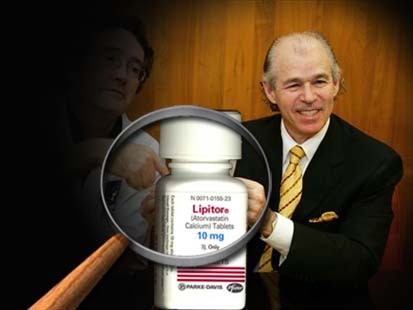
From various sources:
A congressional committee contends the creator of the first artificial heart could have have misled ad viewers by using a body double in advertisements for a popular cholesterol drug he touted in commercials. Yes you read that right, a body double.
Most folks have seen Dr. Robert Jarvik on the air in Lipitor commericals. Congressional investigators believe a body double was hired to make Jarvik look more athletic in television ads for the drug.
If that's not curious enough, Dr. Jarvik cannot legally prescribe medicine, because he is not licensed to practice medicine. Jarvik ended his training after medical school instead of completing a medical internship.
Sources include ABC News.
You can view the ad here:
Apparently the body double was used for the rowing segment, as opposed to the "standing by a labrador retriever" shot. Is the dog even his?
Thursday, February 07, 2008
Did we mean a $1B Zyprexa Settlement? Sorry, that was Confidential
The news that Eli Lilly was working out a deal with with federal and state prosecutors over improper marketing of Zyprexa was the result of an inadvertent leak from one of the lawyers on the matter.
A lawyer at Pepper Hamilton mistakenly sent an e-mail containing a confidential document to a reporter at The New York Times. Seems that the news reporter was named Alex Berenson. He has the same last name as another lawyer who was supposed to have received the e-mail, Bradford Berenson.
Some are calling it "A Nightmare on Email Street."
Thanks to several sites, including Fortune.
A lawyer at Pepper Hamilton mistakenly sent an e-mail containing a confidential document to a reporter at The New York Times. Seems that the news reporter was named Alex Berenson. He has the same last name as another lawyer who was supposed to have received the e-mail, Bradford Berenson.
Some are calling it "A Nightmare on Email Street."
Thanks to several sites, including Fortune.
Merck VP: Vytorin's News is a "Media Event"
From the WSJ Blog:
Ken Frazier from Merck spoke in New York City recently, and he addressed the Vytorin frenzy in the media in recent “We really feel that the Enhance data that has been put out into the public sphere has been mischaracterized,” he said.
Read more about Merck's view here.
Ken Frazier from Merck spoke in New York City recently, and he addressed the Vytorin frenzy in the media in recent “We really feel that the Enhance data that has been put out into the public sphere has been mischaracterized,” he said.
Read more about Merck's view here.
Monday, February 04, 2008
Medtronic SynchroMed EL Implantable Infusion Pump

Today's news brings news of another recall:
The FDA issued a Class I Recall of Medtronic Inc, SynchroMed EL Implantable Infusion Pump Models 8626-10, 8626L-10, 8626-18, 8626L-18, 8627-10, 8627L-10, 8627-18, and 8627L-18.
The device administers drugs to a specific site in the body to treat pain, spasticity (continuous muscle contraction), and cancer. The pump is implanted in the patient, either with or without a side catheter access port, catheters, and catheter accessories. The models were recalled because there is a potential pump motor stall issue that affects SynchroMed EL infusion pumps with motors manufactured before September 1999. If a pump motor stalls, drug delivery will stop suddenly and without warning. This stoppage will result in loss of therapy, return of the patient's symptoms, and/or symptoms of drug under infusion or withdrawal. Healthcare professionals and patients with questions should contact the manufacturer.
Go here for more.
FDA: Chantix Anti-smoking Drug Needs A Warning
Chantix looks to be linked to serious psychiatric behavior, including suicide. Chantix is a smoking cessation medicine.
The FDA reported that after an analysis of cases of depression, suicidal thoughts and other unusual behavior in patients on the medication, the evidence appears stronger of an association with Chantix.
For more go here.
The FDA reported that after an analysis of cases of depression, suicidal thoughts and other unusual behavior in patients on the medication, the evidence appears stronger of an association with Chantix.
For more go here.
Subscribe to:
Posts (Atom)