
Showing posts with label atlanta trucking accident. Show all posts

Friday, October 08, 2010

Trucker Texting Ban

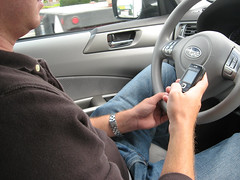
Texting while drivingImage by mrJasonWeaver via FlickrRules prohibiting  texting by Commercial Motor Vehicle (CMV) drivers were  published in the Federal Register. Here are some important points:

  1. Texting increases the risk of a wreck 23.2 times vs. a non-texting driver
  2. A texting violation counts as a serious traffic violation and can disqualify a CDL driver
  3. Federal Employees were forbidden to text and drive on October 6, 2009 (74 FR 51225 and Executive Order 13513)
  4. Texting includes dispatch devices, cell phones, or ANY other texting device such as a laptop
  5. The FMCSA states the Duty to ensure there is no texting by the driver is imposed on the carrier directly.
  6. FMCSR impacted by the ban on texting include:
    1. 383.5    Definitions
    2. 383.51  Disqualifications of Driver
    3. 390.3    General Applicability
    4. 390.5    Definitions
    5. 391       Qualifications of Drivers
    6. 391.2    General Exceptions
    7. 391.15  Disqualification of Drivers
    8. 392.80  Prohibition Against Texting (new)
Enhanced by Zemanta

Wednesday, October 06, 2010

Bad Weather Truck Wrecks in Georgia

Lightning in Perhentian Island, Terengganu, Ma...Image by Fadzly @ Shutterhack via Flickr
A trucker going too fast for roadway conditions in bad weather has always been a serious cause of  wrecks. The question is how do you define “bad weather” and what is the standard for trucker drivers who drive in adverse weather?
 
There is a specific federal regulation – federal motor carrier safety regulation – that addresses this topic.  FMCSR §392.14 says: 
Extreme caution in the operation of a commercial motor vehicle shall be exercised when hazardous conditions, such as those caused by snow, ice, sleet, fog, mist, rain, dust, or smoke, adversely affect visibility or traction. Speed shall be reduced when such conditions exist.  If conditions become sufficiently dangerous, the operation of the commercial motor vehicle shall be discontinued and shall not be resumed until the commercial motor vehicle can be operated safely.  
This FMCSR sets a very high standard of care on professional drivers when operating in anything less than ideal conditions.  This high standard is appropriate because of the dangers posed by trucks in adverse weather conditions.   
The duty to know when it is safe or not is on the trucker, but consider the real world.  Truckers don’t get paid usually unless they are driving.  Some trucking companies put pressure on drivers to get the truck to its destination because the trucking company does not get paid until the freight is delivered.  So, I bet you can see the problem….
Another interesting source on the subject is the CDL manual.  This is the manual all drivers have to study to get their CDL license.  In the CDL Manual, it says:
Wet roads can double stopping distance.  You must drive slower to be able to stop in the same distance as on a dry road.  Reduce speed by abourt one-third (e.g., slow from 55 to 35 mph) on a wet road.  On packed snow, reduce by a half or more.  If the surface is icy, reduce speed to a crawl and stop as soon as you can safely do so. 
It is hard for trucker drivers or trucking safety directors to run from either the Federal Motor Carrier Safety regulations or the CDL Manual when it comes to bad weather. The starting point is always the FMCSA.
Enhanced by Zemanta

Thursday, September 09, 2010

Georgia News: Avandia in the UK

The diabetes drug rosiglitazone (Avandia, GlaxoSmithKline) is once again in the media spotlight  in the UK, where it has emerged that experts from the UK Commission on Human Medicines (CHM) decided unanimously at the end of July that the drug should be withdrawn.


This recommendation was not made public, however, in line with protocol. It was communicated to the British drug-licensing agency, the Medicines and Healthcare Products Regulatory Agency (MHRA), which instead sent out "Dear doctor" letters reiterating safety information with regard to rosiglitazone from 2007, including a suggestion to consider alternative treatments where appropriate.

http://www.theheart.org/article/1120105.do

En Espanol:


El rosiglitazone de la droga de la diabetes (Avandia, GlaxoSmithKline) es una vez más en los medios ilumina con proyector en el RU, donde ha surgido que expertos de la Comisión del RU en Medicinas Humanas (CHM) decidió unánimemente a fines de julio que la droga debe ser retirada. 


Enhanced by Zemanta

Thursday, June 24, 2010

Georgia and Trucking: New Hours of Service Rules - Less Fatigued Drivers?

Daily driving time under a new Hours of Service rule should be reduced by 27 percent, a document filed by a group of safety advocates.  Sourcewww.regulations.gov
 
The document, filed by Henry Jasny on behalf of the Truck Safety Coalition, Public Citizen and Advocates for Highway and Auto Safety, was posted last week on the www.regulations.gov and is one of over 300 documents related to the new rule.

Under the heading Daily Shift Drive Time Maximum, the document reads: “[There should be] No more than eight consecutive hours of driving per shift, based on extensive research findings that show dramatic increase in relative risk of crashes after eight consecutive hours of driving.” 

The document lists basic safety parameters for a new rule:
• 24 hour-circadian schedule
• Lower daily driving and work time limits
• Lower weekly driving and work time maximums
• Increased daily off-duty time, including in sleeper berths
• Increased end-of-week rest time
• Recognition of safety hazards of night-time driving, and
• Universal electronic on-board recorder (EOBR) equipment. 
 
The coalition said it wants to see a maximum of 40 driving hours in a seven-day period and a maximum of 60 hours of work time in a seven-day period.

Tuesday, January 26, 2010

Trucking News: Federal Government Bans Truckers and Bus Drivers from Texting

The government Tuesday formally barred truckers and bus drivers from sending text messages while behind the wheel, putting the federal imprimatur on a prohibition embraced by many large trucking and transportation companies.

"We want the drivers of big rigs and buses and those who share the roads with them to be safe," said U.S. Transportation Secretary Ray LaHood. "This is an important safety step, and we will be taking more to eliminate the threat of distracted driving."

Although both houses of Congress are considering bills restricting texting and 19 states have banned the practice, LaHood said existing rules on truckers and bus drivers give him authority to issue the prohibition. LaHood said drivers of commercial vehicle caught texting could be fined up to $2,750.

source:http://www.washingtonpost.com/wp-dyn/content/article/2010/01/26/AR2010012602031.html